Tesla is rewriting the rules of connectivity. A bombshell patent filing reveals a future where dead zones vanish. Elon Musk is merging his two greatest empires: Tesla and SpaceX. The goal is simple. Total global dominance through satellite-integrated vehicles.
For years, drivers faced a digital wall. Metal car roofs act like cages. They block signals. They kill high-speed data. Tesla’s new patent, published on December 4, 2025, shatters that wall. It introduces a revolutionary “Radio Frequency Transparent” roof. This is not just a sunroof. It is a gateway to the stars.
The Death of the Dead Zone
Connectivity is the lifeblood of the modern electric vehicle. Tesla relies on data. It needs data for Autopilot. It needs data for over-the-air updates. It needs data for the massive screens inside the cabin. Today, that data comes from cellular towers.
But towers have limits. They fail in mountains. They disappear in deserts. They collapse during natural disasters. This is a fatal flaw for a self-driving future. A Robotaxi cannot lose its mind in a tunnel or a rural valley. It must stay awake. It must stay connected.
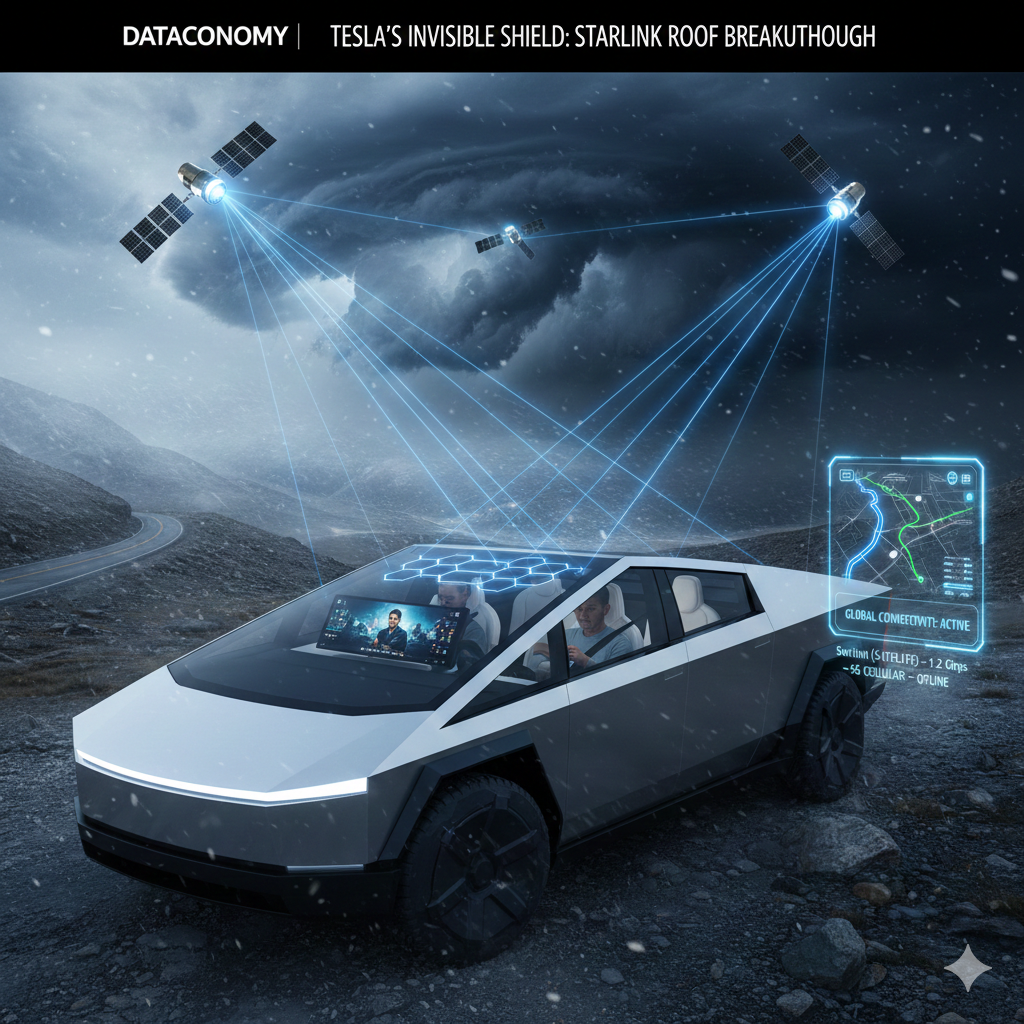
Tesla’s solution is the Starlink antenna. By burying these receivers directly into the car’s roof, Tesla creates a permanent link to the SpaceX constellation. This is “always-on” internet. It works in the middle of a hurricane. It works in the heart of the Sahara.
The Engineering Miracle: Hidden in Plain Sight
Traditional satellite dishes are ugly. They are bulky. They ruin aerodynamics. Tesla refuses to sacrifice style. The new patent describes a multi-layered sandwich of high-tech polymers.
Engineers are using Polycarbonate (PC) and Acrylonitrile Styrene Acrylate (ASA). These are not standard plastics. These materials offer the strength of steel. They offer the clarity of glass. Crucially, they allow radio waves to pass through like ghosts.
The antenna sits beneath this skin. It is invisible to the eye. It is perfectly aerodynamic. It adds zero drag. This engineering feat allows Tesla to maintain its sleek, futuristic silhouette while housing the most powerful communication tool on Earth.
Powering the Robotaxi Revolution
Why does this matter now? The answer is autonomy. Tesla is betting everything on the Robotaxi. These autonomous fleets require massive bandwidth. They need real-time HD maps. They need constant communication with a central command.
A cellular glitch could paralyze an autonomous fleet. Starlink removes that risk. It provides a redundant, high-speed backbone. If the 5G network fails, the car switches to space. This seamless handoff ensures safety. It ensures reliability. It makes Tesla the only car company capable of operating truly anywhere.
An Entertainment Powerhouse
The benefits aren’t just for the computers. They are for the humans inside. As cars become mobile lounges, passengers want more. They want 4K streaming. They want lag-free gaming. They want high-fidelity video calls.
Current LTE and 5G connections often throttle during peak hours. Starlink does not. With a direct-to-satellite link, every Tesla becomes a rolling high-speed office. It becomes a theater on wheels. This transforms the commute. It turns a boring drive into a productive or entertaining experience. This is a massive competitive edge. Other manufacturers are tethered to the ground. Tesla is tethered to the heavens.
The Musk Synergy: A Vertical Empire
No other automaker can do this. Ford cannot build its own satellite network. Toyota cannot launch rockets. Elon Musk owns the infrastructure of the future.
SpaceX has already launched thousands of Starlink satellites. They are already testing “Direct-to-Cell” technology. The “STARLINK MOBILE” trademark is already active. This patent is the final piece of the puzzle. It creates a closed-loop ecosystem.
Tesla builds the car. SpaceX provides the internet. The customer gets an unparalleled experience. The revenue stays within the Musk empire. It is a masterstroke of vertical integration. It creates a barrier to entry that legacy carmakers cannot overcome.
Breaking the Regulatory Chains
Tesla currently faces intense scrutiny. Regulators in California are questioning “Full Self-Driving” claims. Market competition is fierce. Sales have fluctuated. Tesla needs a “wow” factor.
This satellite integration is that factor. It moves the goalposts. It shifts the conversation from battery range to digital capability. In the 20th century, horsepower was king. In the 21st century, data is the crown. Tesla is hoarding that data.
The Global Impact
This technology has massive implications for global safety. Imagine a Tesla in a remote area during a wildfire. The driver needs evacuation routes. The cell towers are burned out. The Tesla remains online. It receives emergency broadcasts. It guides the family to safety via satellite.
Imagine a scientist in the Arctic. Imagine a doctor in a developing nation. This technology brings the world closer. It democratizes information. It proves that the car is no longer just a mode of transport. It is a tool for survival and connection.
The Competition is Scrambling
Rivian and Lucid are watching. They are trying to catch up on battery tech. But they are lightyears behind on connectivity. While they negotiate with telecom giants, Tesla is building its own sky.
The industry is at a crossroads. Some companies will remain “dumb” cars with big batteries. Tesla is becoming a “smart” node in a global mesh network. The gap is widening. The “Invisible Starlink Shield” is more than a patent. It is a declaration of war against the status quo.
Looking Ahead: 2026 and Beyond
Production of the RF-transparent roof could begin soon. Reports suggest the Cybertruck or the upcoming “Model 2” might be the first to feature this tech. If successful, it will become standard across the fleet.
The world is changing. The sky is no longer the limit; it is the source. Tesla’s patent is a bold step into the unknown. It promises a world where you are never lost. A world where you are never offline. A world where your car is your most powerful connection to the rest of humanity.
Elon Musk promised the future. With this patent, he is delivering it—one satellite beam at a time. The era of the truly connected car has arrived.