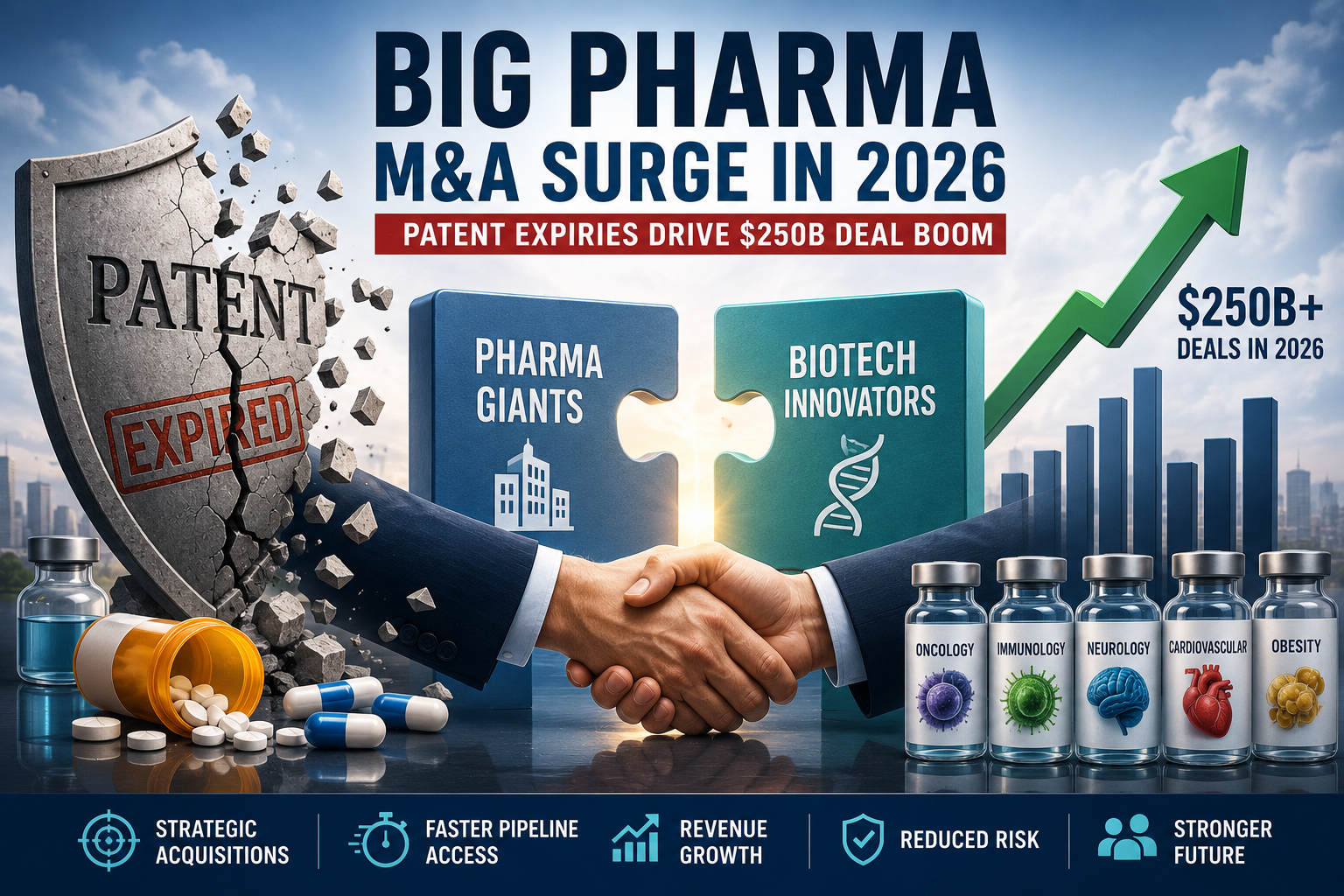
The global pharmaceutical industry is charging into one of its most aggressive deal-making cycles in years. Driven by looming patent expiries and urgent pipeline gaps, large drugmakers are accelerating mergers and acquisitions (M&A) at a breakneck pace. Analysts now expect 2026 to emerge as a mega year, with total deal value likely to exceed $250 billion, rivaling the industry’s strongest periods of consolidation.
This surge is not random. It is strategic. It is urgent. And it reflects a deep structural shift in how pharmaceutical giants sustain growth in a post-patent world.
Patent Cliff vs Growth Ambition: The Core Trigger
At the heart of this deal frenzy lies a powerful force—the patent cliff. Over the next few years, several blockbuster drugs will lose exclusivity. Once patents expire, generic competition floods the market. Prices fall sharply. Revenues shrink fast.
Industry estimates suggest that over $300 billion in annual sales could be at risk by the end of the decade. This creates a stark reality for big pharma: replace lost revenue or face decline.
In the past, companies relied heavily on internal research and development (R&D). Today, that approach looks too slow and uncertain. Drug discovery takes years. Clinical trials carry high failure rates. Regulatory hurdles add more delays.
Now, compare that with acquisitions.
- R&D route: High risk, long timelines, uncertain returns
- M&A route: Faster access, proven assets, immediate pipeline boost
The choice is clear. Companies are buying growth instead of waiting for it.
Deal Momentum: 2026 vs Previous Years
The scale of activity in 2026 already signals a breakout year.
- Q1 2026 deal value: ~$84 billion
- Growth vs last year: Nearly doubled
- Projected full-year value: $250 billion+
In contrast, dealmaking slowed in recent years due to macroeconomic uncertainty and valuation gaps. However, 2026 shows a decisive rebound.
This time, urgency is stronger. Balance sheets are healthier. And strategic clarity is sharper.
Cash-Rich Giants vs Undervalued Biotech: A Perfect Match
Another major driver of the M&A boom is the widening gap between cash-rich pharmaceutical giants and undervalued biotech firms.
Large pharma companies currently sit on massive cash reserves. Strong drug sales during recent years have boosted liquidity. At the same time, biotech valuations have corrected after market volatility.
This creates a powerful buying window.
- Big pharma sees opportunity
- Biotech seeks capital and scale
- Deals bridge the gap
This alignment is fueling a steady pipeline of acquisitions across early-stage, mid-stage, and late-stage assets.
Small Deals vs Mega Mergers: A Strategic Shift
Unlike previous cycles dominated by massive mergers, 2026 is witnessing a strategic pivot toward mid-sized and bolt-on acquisitions.
This shift reflects smarter capital allocation.
Earlier Approach:
- Large, complex mega-mergers
- High integration risks
- Long realization timelines
Current Approach:
- Multiple targeted acquisitions
- Focus on specific therapies or assets
- Faster integration and returns
Companies now prefer precision over scale. They aim to fill exact gaps in their pipelines rather than overhaul entire organizations.
Therapy Wars: Where the Money Is Flowing
Not all therapeutic areas attract equal attention. Pharma companies are aggressively targeting segments with strong commercial potential and long-term demand.
Key Focus Areas:
- Oncology: Continues to dominate due to high unmet need and premium pricing
- Immunology: Strong growth driven by chronic disease treatments
- Neurology: Rising demand for therapies addressing complex brain disorders
- Cardiovascular: Large patient base ensures sustained revenue
- Obesity and metabolic drugs: Rapidly emerging blockbuster category
These segments promise not just innovation, but multi-billion-dollar revenue streams.
Speed vs Certainty: The Rise of Late-Stage Assets
Another defining feature of the current M&A wave is the preference for late-stage or near-commercial assets.
Pharma companies are prioritizing:
- Drugs in Phase 2 or Phase 3 trials
- Therapies with strong clinical data
- Assets with clear regulatory pathways
Why? Because these deals offer higher certainty and faster monetization.
Compare the options:
- Early-stage biotech: High innovation, high risk
- Late-stage assets: Lower risk, faster returns
In a high-pressure environment shaped by patent losses, certainty wins.
Strategic Imperative vs Opportunistic Buying
Experts emphasize that this M&A surge is not just opportunistic—it is structural and strategic.
Pharma companies are not buying randomly. They are executing carefully planned portfolio strategies.
Key objectives include:
- Replacing expiring blockbuster revenues
- Strengthening core therapeutic areas
- Expanding into high-growth segments
- Gaining access to breakthrough technologies
This reflects a shift from reactive dealmaking to proactive growth engineering.
Global Impact: Winners and Opportunities
The ripple effects of this M&A boom extend beyond large corporations.
For Biotech Firms:
- Increased acquisition interest
- Better funding opportunities
- Higher exit valuations
For Investors:
- Renewed confidence in life sciences
- Strong deal-driven market activity
For Generic Drug Makers (Including India):
- Patent expiries open massive opportunities
- Increased production of affordable alternatives
- Strong export potential
India, in particular, stands to gain significantly. As patents expire globally, Indian pharmaceutical companies can expand their footprint in generics and biosimilars.
Risks Beneath the Surge
Despite strong momentum, the deal wave is not without risks.
- Overpaying for assets amid competition
- Integration challenges post-acquisition
- Regulatory hurdles in cross-border deals
- Clinical trial failures even in late-stage drugs
Companies must balance speed with discipline. Strategic clarity will separate successful deals from costly mistakes.
The Road Ahead: A New Pharma Playbook
The 2026 M&A surge signals a deeper transformation in the pharmaceutical industry.
The old model—slow, internal, R&D-heavy growth—is evolving. In its place, a hybrid strategy is emerging:
- Build internally
- Buy externally
- Partner strategically
This integrated approach allows companies to move faster, reduce risk, and stay competitive in a rapidly changing landscape.
Conclusion: A Defining Year for Pharma
The message is clear. Patent expiries have triggered a high-stakes race for survival and growth. Pharmaceutical giants are responding with bold, calculated moves.
With over $250 billion in deals expected, 2026 is not just another active year—it is a defining moment.
The winners will be those who act fast, choose wisely, and execute flawlessly.
In the battle between expiring patents and future innovation, M&A has become the industry’s most powerful weapon.