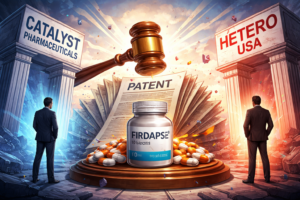
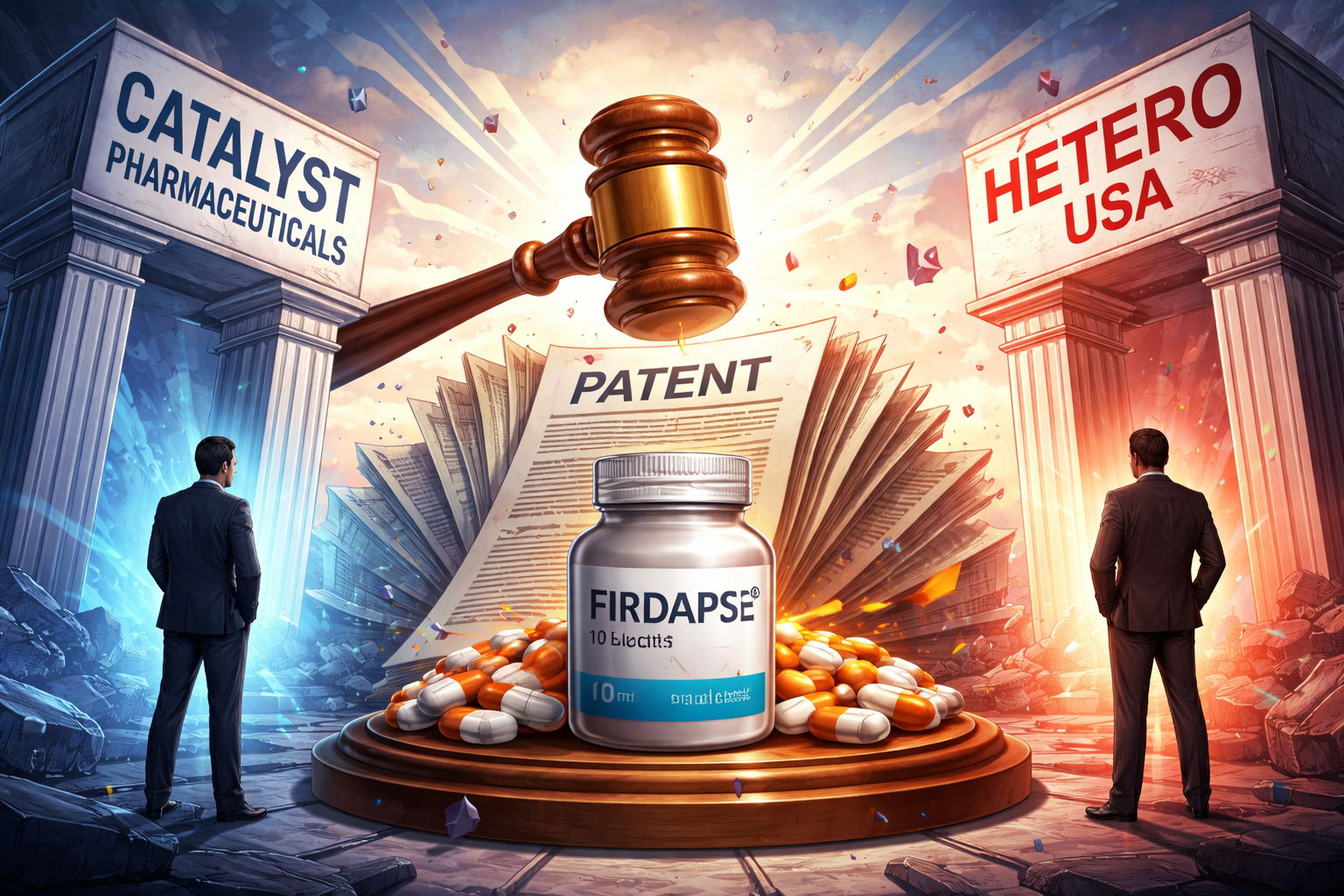
A U.S. federal court has postponed a critical patent trial between Catalyst Pharmaceuticals and Hetero USA Inc., delaying a closely watched legal fight that could reshape competition in the rare disease drug market.
The bench trial, initially set for March 23, 2026, will now begin on May 18, 2026. The delay extends uncertainty for investors, patients, and generic drug manufacturers who are tracking the case’s outcome.
A Legal Battle With High Commercial Stakes
At the center of the dispute is FIRDAPSE, Catalyst’s flagship therapy used to treat Lambert-Eaton myasthenic syndrome (LEMS), a rare neuromuscular disorder. The drug represents a major portion of Catalyst’s revenue and strategic focus.
Catalyst claims that several patents protecting FIRDAPSE remain valid and enforceable. These patents are listed in the FDA’s Orange Book and are scheduled to expire between 2032 and 2037.
Hetero USA, a generic drug manufacturer, is challenging those patents. The company aims to launch a lower-cost version of the drug before those expiration dates.
This sets up a classic pharmaceutical conflict: innovation protection versus affordable access.
What the Delay Means
The court’s decision to postpone the trial does not alter the substance of the case. However, it has immediate and long-term implications.
Immediate impact
- Extends legal uncertainty
- Delays potential market entry for generics
- Keeps pricing power in Catalyst’s hands for now
Long-term impact
- Shifts investor timelines
- Affects strategic planning for both companies
- Prolongs regulatory and commercial ambiguity
In simple terms, the delay buys time—but not clarity.
Catalyst vs Hetero: A Clear Contrast
Catalyst’s Position: Defend Innovation
Catalyst Pharmaceuticals argues that its patents reflect years of research, clinical investment, and regulatory work.
The company wants to:
- Protect exclusivity for FIRDAPSE
- Maintain premium pricing
- Secure long-term revenue stability
Catalyst has already settled similar disputes with other generic players, including major firms such as Teva Pharmaceutical Industries and Lupin Limited.
Those settlements strengthened Catalyst’s legal position. Now, Hetero remains one of the last major challengers.
Hetero’s Position: Open the Market
Hetero USA Inc. is pushing for early market entry.
The company aims to:
- Invalidate or bypass patents
- Launch a generic alternative
- Capture market share with lower pricing
Generic entry typically leads to:
- Price reductions of 30% to 80%
- Wider patient access
- Increased competition
For Hetero, the case represents a strategic opportunity to break into a niche but profitable market.
Why This Case Matters for the Industry
This is not just a company-level dispute. It reflects a broader shift in the pharmaceutical sector.
1. Rising Patent Challenges
Across the industry, generic companies are increasingly aggressive. They challenge patents earlier and more often. This trend intensifies as blockbuster and niche drug patents approach expiration.
The Catalyst-Hetero case fits squarely into this pattern.
2. Pressure on Rare Disease Drugs
Rare disease treatments often enjoy:
- Smaller patient populations
- Higher prices
- Longer exclusivity periods
But these advantages are now under pressure. Governments, insurers, and patients demand more affordable options.
If Hetero succeeds, it could signal a shift:
- Even niche drugs may face earlier competition
- Patent defenses may become harder to sustain
3. Financial Stakes
For Catalyst, the outcome is critical.
If Catalyst wins:
- It retains market exclusivity until at least 2032
- Revenue streams remain strong
- Investor confidence improves
If Hetero wins:
- Generic competition could arrive years earlier
- Prices could drop sharply
- Revenue could decline significantly
This binary outcome explains why the case attracts intense attention.
Market Reaction and Investor Sentiment
The delay introduces a new variable into Catalyst’s outlook.
Investors now face:
- A longer wait for legal resolution
- Continued uncertainty over future earnings
- Increased sensitivity to legal updates
However, Catalyst still benefits from:
- Strong recent financial performance
- A focused rare disease portfolio
- Limited direct competition—for now
Market analysts suggest that while the delay is not negative, it extends risk exposure.
The Broader Legal Landscape
Patent litigation remains a cornerstone of the pharmaceutical business model. Companies rely on patents to recover research investments. Generic firms rely on legal challenges to create competition.
This tension drives innovation—but also fuels constant litigation.
In recent years:
- Courts have shown mixed outcomes in patent disputes
- Some patents have been upheld strongly
- Others have been invalidated earlier than expected
This unpredictability makes every case significant.
The Catalyst-Hetero dispute is no exception.
What Happens Next
With the new trial date set for May 18, 2026, both sides will continue preparing their arguments.
Key issues likely to dominate the trial include:
- Patent validity
- Scope of protection
- Scientific and regulatory evidence
The court’s decision will ultimately determine:
- Whether Hetero can launch a generic version
- How long Catalyst retains exclusivity
- The future pricing of FIRDAPSE
A Defining Moment for a Niche Market
The delay may seem procedural. But its implications run deep.
This case will:
- Shape competitive dynamics in a rare disease segment
- Influence future patent challenges
- Impact patient access and drug affordability
For now, the balance of power remains with Catalyst. But the clock is ticking.
Conclusion
The postponed trial between Catalyst Pharmaceuticals and Hetero USA Inc. underscores a fundamental truth in the pharmaceutical industry: patents define power.
Catalyst seeks to defend its innovation and revenue. Hetero aims to disrupt and democratize access. The court will decide which vision prevails.