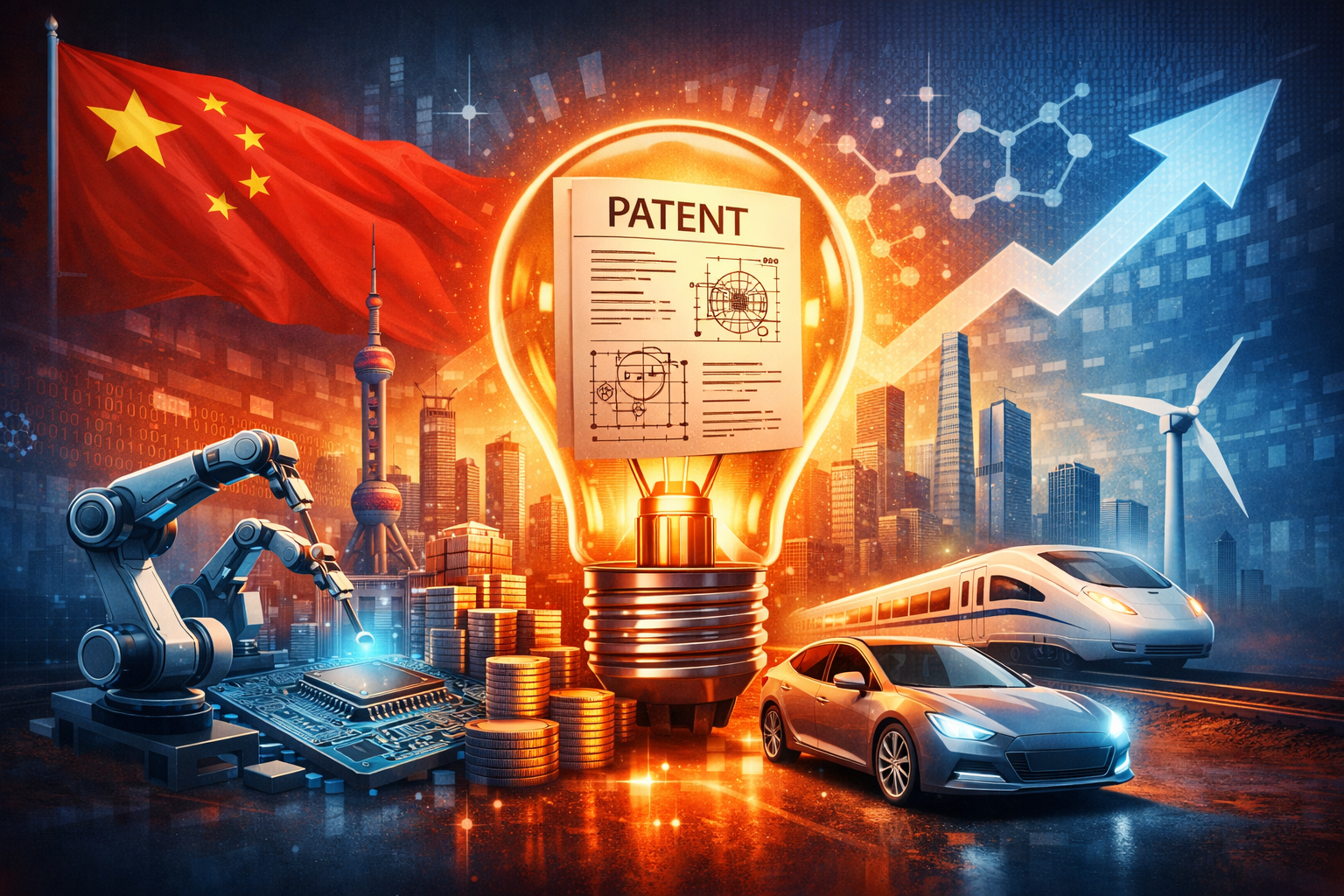
China is accelerating efforts to transform patents into real economic power. Policymakers now want intellectual property to move beyond legal protection and become a direct engine of industrial growth. The shift reflects a broader strategy: convert scientific breakthroughs into marketable technologies that strengthen China’s global competitiveness.
Officials increasingly emphasize that patents must generate tangible economic results. Research achievements alone no longer satisfy policymakers. Instead, China is pushing for an innovation ecosystem where patents move quickly from laboratories to factories, startups, and global markets.
This policy transition marks a major shift in China’s intellectual-property strategy. For years, the country focused on building one of the world’s largest patent portfolios. Today, the emphasis has moved toward commercialization, quality, and economic impact.
From Patent Quantity to Real Economic Value
China dominates global patent filings. The country holds millions of valid invention patents and continues to lead international patent application trends. For more than a decade, the government encouraged aggressive patent filings through policy incentives, research funding, and industrial strategies.
This approach helped China rapidly build a massive intellectual-property base. Universities, state-owned enterprises, and private companies all contributed to the surge in patent activity.
However, the rapid expansion in patent numbers also triggered debate among policymakers and analysts. Critics argued that high filing volumes alone do not guarantee innovation strength. A patent becomes valuable only when it leads to real technology, products, or services.
Chinese authorities have increasingly acknowledged this challenge. The next phase of innovation policy now focuses on converting intellectual property into economic productivity.
Recent data shows that the industrialization rate of enterprise invention patents has steadily increased. More than half of corporate patents are now used in real industrial applications, ranging from advanced manufacturing processes to digital technologies.
The shift reflects a deliberate move from a patent-quantity model toward a quality-driven innovation system.
Government Push to Strengthen Commercialization
To accelerate patent commercialization, Chinese regulators are strengthening the link between intellectual property and market forces.
Authorities are promoting policies that encourage companies, universities, and research institutions to cooperate more closely. These initiatives aim to solve a long-standing issue in China’s innovation system: strong research output but limited technology transfer.
Several measures support this effort.
The government is expanding national patent-operation platforms that allow companies to buy, license, or share intellectual property more easily. Technology-transfer services are also being strengthened to help innovators connect with potential investors and industrial partners.
Another key initiative involves patent pools. These mechanisms allow multiple patent owners to license technologies collectively. By reducing licensing barriers, patent pools encourage faster adoption of new technologies and support industry-wide innovation.
Policymakers are also improving incentives for research institutions. Universities and scientists now receive stronger financial rewards when their patents reach the market. This change encourages researchers to focus not only on discovery but also on commercialization.
The policy direction is clear. Innovation must produce real economic value.
Universities Move Closer to Industry
Universities and research institutes hold a significant share of valuable patents in China. Historically, however, many of these patents remained unused or underutilized.
To address this gap, authorities are promoting stronger collaboration between academic institutions and private companies.
Several regions have launched experimental programs that allow unused university patents to be transferred to small and medium-sized enterprises. These programs enable businesses to adopt advanced technologies while giving universities new opportunities to monetize research.
This approach benefits both sides. Companies gain access to cutting-edge technology, while academic institutions receive financial returns and practical impact from their research.
Officials hope such initiatives will unlock thousands of dormant patents and create new business opportunities across China’s economy.
Enterprises Become the Core Innovation Engine
China’s innovation ecosystem is increasingly driven by companies rather than government laboratories.
Enterprises now hold the majority of invention patents and account for most commercialization activities. Businesses are closer to markets and consumer needs, which allows them to convert research breakthroughs into profitable products more efficiently.
High-tech companies play a particularly important role. These firms invest heavily in research and development and actively integrate patents into production and product design.
The commercialization rate of patents within high-tech enterprises has grown significantly in recent years. This trend highlights the strong connection between corporate research investment and technological output.
However, smaller firms still face challenges in transforming patents into marketable products. Limited funding, insufficient commercialization expertise, and regulatory complexity can slow the process.
Chinese authorities are expanding support programs to help small and medium-sized companies overcome these barriers.
Strategic Industries Drive Patent Transformation
China’s patent commercialization strategy focuses heavily on emerging technologies.
High-value patents are increasingly concentrated in strategic sectors such as artificial intelligence, green energy, biotechnology, advanced manufacturing, and digital communications.
These industries form the backbone of China’s innovation-driven development strategy. Companies in these sectors invest heavily in research while building large patent portfolios to secure technological leadership.
Artificial intelligence and new energy technologies stand out as particularly dynamic areas of innovation. Chinese companies in these sectors continue to file large numbers of patents while developing new products for global markets.
The government views these technologies as critical to long-term economic competitiveness. By strengthening commercialization in these sectors, China hopes to accelerate industrial upgrading and reduce dependence on foreign technologies.
Patent-Intensive Industries Fuel Economic Growth
The growing commercialization of patents is already contributing significantly to China’s economy.
Industries that rely heavily on intellectual property generate enormous economic value. These patent-intensive sectors include high-tech manufacturing, information technology, pharmaceuticals, and telecommunications.
Together, they contribute a large share of the country’s gross domestic product and provide employment for millions of workers.
The expansion of these industries demonstrates how intellectual property increasingly drives economic activity, industrial transformation, and job creation.
As commercialization improves, patents are expected to play an even larger role in shaping China’s economic future.
Global Competition Shapes China’s Strategy
China’s commercialization push also reflects intensifying global competition in technology.
Countries around the world are racing to dominate emerging technologies such as artificial intelligence, semiconductors, robotics, and clean energy.
China’s rapid growth in patent filings has already reshaped the global innovation landscape. The country now ranks among the world’s leading sources of technological innovation.
Yet policymakers understand that patents alone do not guarantee technological leadership.
True innovation leadership requires strong commercialization capabilities. Technologies must move from patents to production lines and ultimately to global markets.
This realization drives China’s latest policy focus.
Challenges Ahead
Despite strong progress, several obstacles remain.
First, patent quality still varies widely. Some patents represent incremental improvements rather than groundbreaking innovations.
Second, commercialization capabilities remain uneven across regions. Major innovation hubs such as Beijing, Shenzhen, and Shanghai lead the transformation, while other regions lag behind.
Third, coordination between universities, research institutions, and companies still needs improvement.
Chinese policymakers are working to address these challenges through regulatory reforms, financial incentives, and stronger intellectual-property infrastructure.
The Next Phase of China’s Innovation Strategy
China’s push for patent commercialization marks a decisive shift in its innovation policy.
The country is no longer satisfied with simply leading the world in patent filings. Instead, it seeks to transform intellectual property into real economic strength.
If successful, this strategy could reshape global technology competition.
By converting patents into products, industries, and export capabilities, China aims to build a powerful innovation-driven economy—one where intellectual property fuels long-term growth, industrial strength, and technological leadership.