
India’s higher education sector faces tough questions after controversy erupted at the India AI Impact Summit 2026. What began as a technology showcase quickly turned into a national debate on research credibility, patent quality, and the widening gap between private universities and premier public institutions.
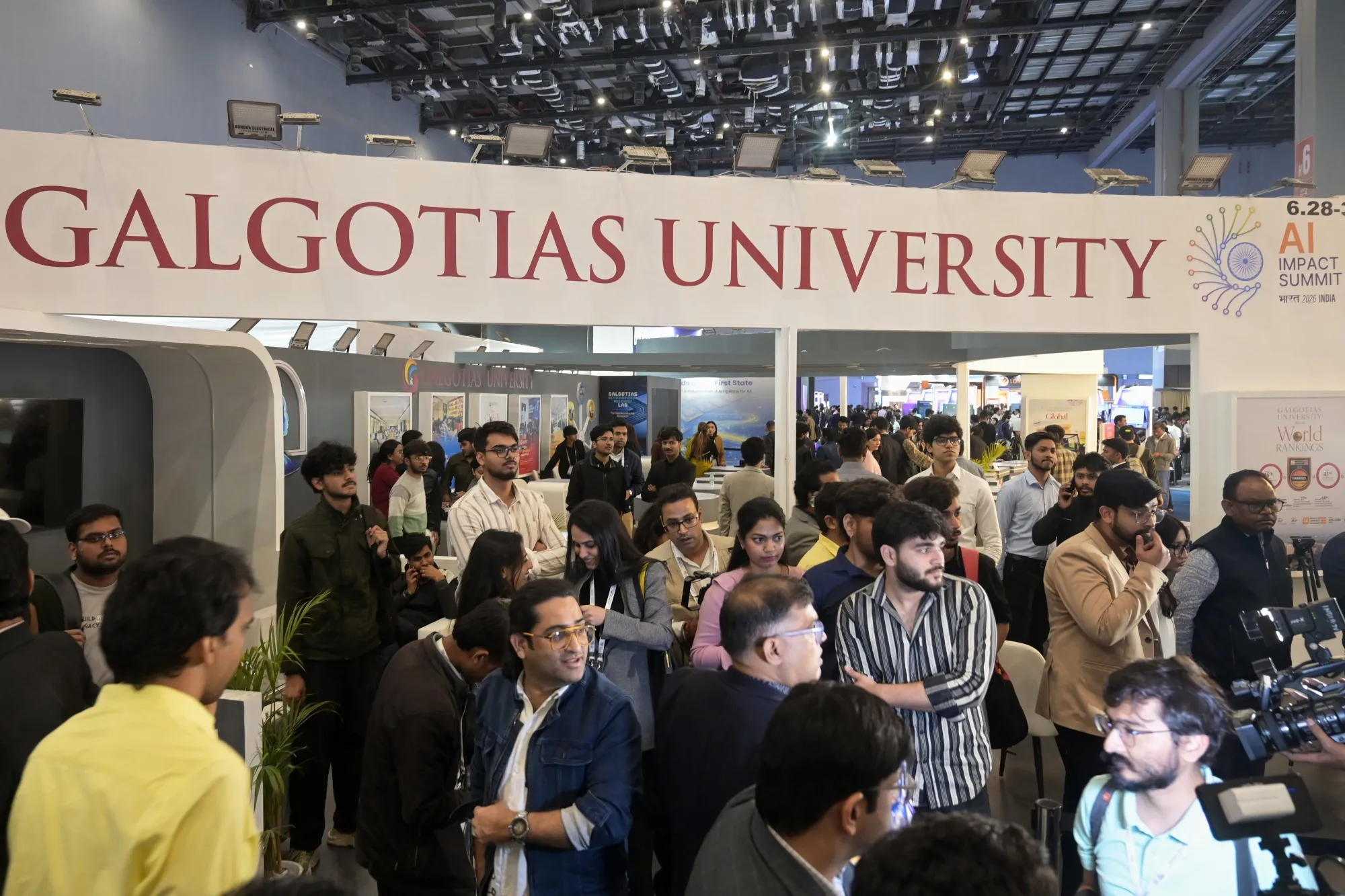
At the center stands Galgotias University. The institution drew attention for displaying a robotic dog at the summit. A faculty representative reportedly introduced the robot as “Orion,” presenting it as part of the university’s innovation ecosystem.
Within hours, social media users identified the machine as the Unitree Go2, a commercially available robotic dog manufactured in China.
The backlash was swift. The controversy snowballed. And the focus shifted from robotics to research integrity.
A Showcase Turns Into a Storm
The summit aimed to highlight India’s growing artificial intelligence ecosystem. Government officials, academic leaders, startups, and global tech firms gathered to showcase breakthroughs.
Instead, the spotlight shifted to a question that cuts deep: Are some institutions projecting innovation without producing it?
Reports indicate summit organizers asked Galgotias University to vacate its stall following the uproar. The university later clarified that it had procured the robot for student learning and did not manufacture it. However, critics argue that earlier representations created confusion.
Political reactions intensified the matter. Leaders from the Samajwadi Party publicly criticized the episode. Calls for investigation echoed in Uttar Pradesh. The office of Chief Minister Yogi Adityanath faced demands to examine the claims.
The incident transformed into a broader conversation about transparency in academia.
Patent Numbers: Quantity vs Quality
The controversy gained sharper edges when patent data surfaced.
According to publicly cited figures, Galgotias University has filed over 2,000 patent applications. Yet only about 1% have reportedly been granted.
The number sounds impressive at first glance. Thousands of filings suggest research momentum. But patent experts stress a critical distinction: filing is not granting.
A patent application signals intent. A granted patent proves novelty and inventiveness.
The contrast becomes striking when compared with institutions like IIT Bombay and IIT Madras. These premier institutes show significantly higher grant ratios. Their filings often undergo rigorous peer validation, industry collaboration, and global scrutiny.
The difference highlights a structural divide.
Private universities often emphasize volume. Public research institutes prioritize depth.
The Private University Model
Private universities in India have expanded rapidly over the past decade. They market industry-ready degrees. They invest in infrastructure. They promote patent filing drives among faculty and students.
In this race, numbers become marketing tools.
“Over 2,000 patents filed” sounds powerful on brochures. It signals innovation leadership. It attracts admissions.
But experts argue that innovation cannot rely on optics alone.
When grant rates remain low, questions emerge about patent quality. Are filings incremental? Are they adequately researched? Do they meet global standards?
These questions now dominate discussions after the summit episode.
A Comparative Lens: IITs vs Private Institutions
The IIT system operates under a different ecosystem.
Institutes like IIT Bombay and IIT Madras maintain long-standing research partnerships with global universities and industry leaders. Their faculty publish extensively in peer-reviewed journals. Their technology transfer offices focus on commercialization.
This creates a virtuous cycle.
Research leads to patents. Patents lead to startups. Startups attract funding. Funding fuels deeper research.
In contrast, many private universities prioritize teaching revenue models. Research often grows as a parallel initiative rather than a foundational pillar.
This structural difference does not mean private institutions lack innovation. Some have built strong labs and incubation centers. However, the summit controversy has exposed how fragile credibility can be when presentation outpaces proof.
Lovely Professional University: A Parallel Case
Another private institution frequently cited in patent discussions is Lovely Professional University. LPU has also reported high patent filing volumes in recent years.
Supporters argue that private universities democratize research by encouraging student participation in intellectual property filing. Critics counter that rapid filing drives can dilute focus on breakthrough research.
The debate is not about public versus private alone. It is about standards versus symbolism.
The Robot Dog as a Symbol
The robotic dog incident became symbolic.
The machine itself was not illegal. Purchasing global technology for educational use is common practice. Engineering labs worldwide buy robotic platforms for experimentation.
The problem arose from perception.
When a global tech platform appears as a homegrown innovation, credibility erodes. In an era of instant digital verification, such claims collapse quickly.
The episode underscores a harsh truth: transparency is no longer optional.
India’s AI Moment at Stake
India positions itself as a global AI leader. Policymakers promote domestic innovation. Startups scale rapidly. Government initiatives fund research.
Summits like the India AI Impact Summit serve as platforms to project this ambition.
Therefore, controversies risk reputational damage beyond a single institution.
When global observers watch such events, they assess not only individual universities but the ecosystem’s maturity.
Strong ecosystems celebrate genuine breakthroughs. They also enforce accountability.
The Power Cut Reports and Public Perception
Media reports claimed that power supply to the controversial stall was cut during the summit. Whether symbolic or procedural, the image resonated widely.
In the court of public opinion, symbolism matters.
The narrative shifted from a single robotic dog to broader concerns about research authenticity in India’s rapidly expanding private education sector.
Universities now face pressure to demonstrate not just filings, but functional prototypes, peer-reviewed validation, and commercial deployment.
What Comes Next?
The controversy may fade from headlines. But the underlying questions will remain.
Will private universities recalibrate their research metrics?
Will patent filing drives shift toward deeper vetting?
Will policymakers tighten oversight on academic claims at national summits?
For institutions like Galgotias University, the path forward requires decisive action. Clear communication. Transparent data. And measurable outcomes.
For India’s AI ecosystem, the episode offers a wake-up call.
Innovation demands substance. Reputation demands integrity. And credibility demands proof.
A Defining Moment for Academic Credibility
The AI summit row exposed a stark contrast.
On one side stand institutions with decades of research legacy, high patent grant ratios, and global academic footprints. On the other side stand ambitious private universities pushing aggressive expansion and high-volume intellectual property strategies.
Both models aim to contribute to India’s knowledge economy.
But only one factor ultimately defines success: impact.
Patents must translate into products. Prototypes must evolve into startups. Claims must align with facts.
The robotic dog controversy may become a footnote in India’s AI journey. Yet it has already sparked a crucial debate.