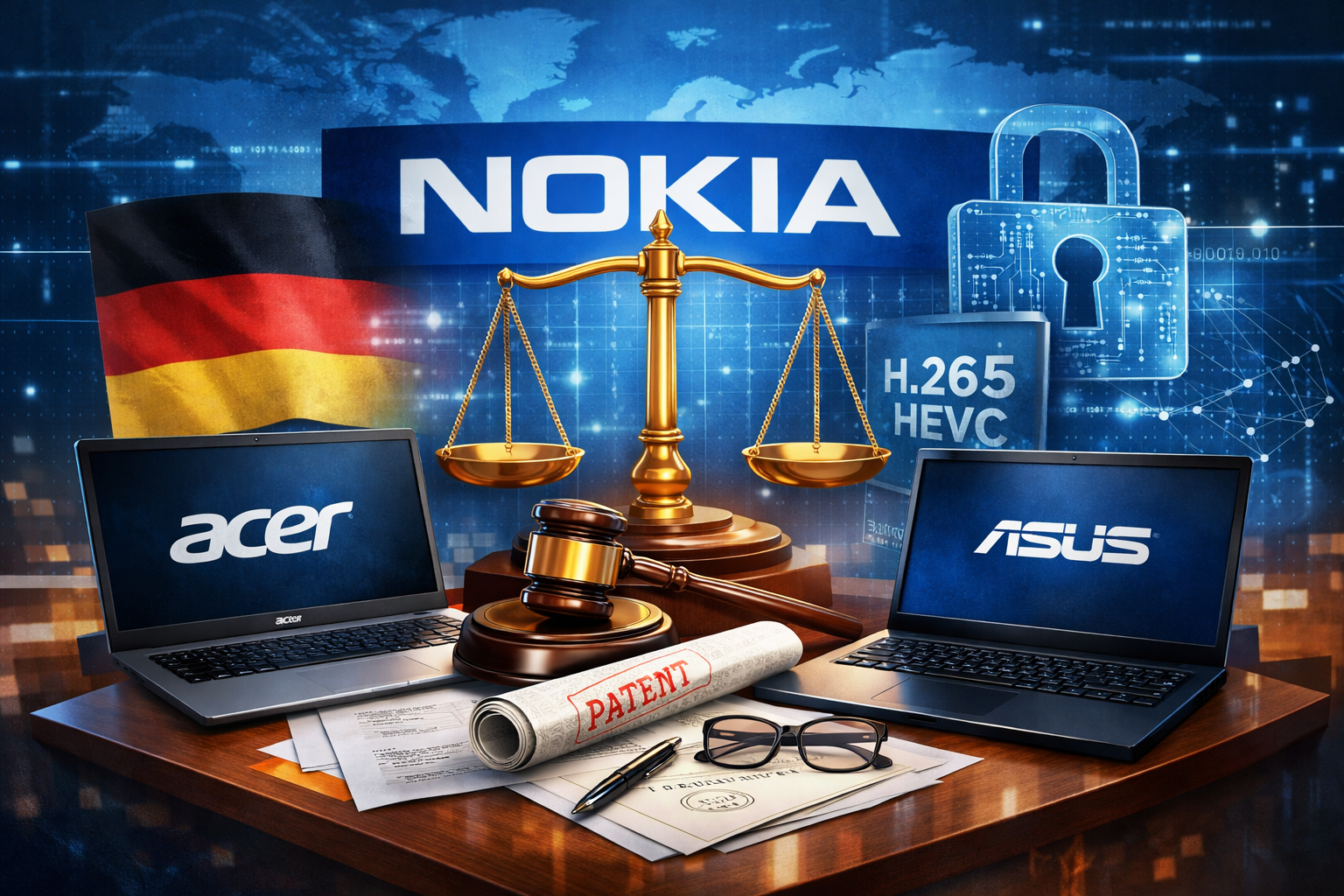
A fresh patent ruling in Germany has sent shockwaves through the global PC industry. Finnish telecom giant Nokia secured a decisive legal victory against PC manufacturers Acer and ASUS, resulting in a court-ordered ban on certain computer sales within one of Europe’s largest technology markets.
The judgment highlights the growing power of standard-essential patents (SEPs) in shaping competition and licensing practices across the technology sector. It also reinforces Germany’s position as a strategic battleground for global patent enforcement.
A Landmark Court Decision With Immediate Consequences
The ruling came from the Munich I Regional Court, a venue known for its swift handling of intellectual property disputes. The court sided with Nokia in a long-running conflict centered on High Efficiency Video Coding (HEVC), also known as H.265.
HEVC is a modern video compression standard used across devices for high-resolution video playback and streaming. Because the technology is widely adopted, it relies on standard-essential patents. Companies implementing such standards must obtain licenses from patent holders under Fair, Reasonable, and Non-Discriminatory (FRAND) terms.
According to the court, Acer and ASUS failed to demonstrate that they were “willing licensees.” That determination proved critical. Under European SEP jurisprudence, companies can avoid injunctions if they show genuine willingness to negotiate licensing agreements. The court concluded that this threshold was not met.
As a result, the decision grants Nokia the right to enforce an injunction against the sale, marketing, and import of certain PCs in Germany that use the contested technology.
Understanding the HEVC Patent Dispute
The core of the case revolves around HEVC video compression technology. HEVC enables efficient playback of high-definition and ultra-high-definition video while reducing bandwidth requirements. It plays a central role in streaming platforms, multimedia editing, and modern computing environments.
Nokia owns a portfolio of patents considered essential to implementing the HEVC standard. These patents give the company leverage to demand licensing fees from manufacturers whose devices support HEVC decoding or encoding.
Acer and ASUS reportedly disputed the licensing terms offered by Nokia. Negotiations stalled, prompting litigation. Nokia argued that the companies continued selling devices without securing valid licenses, thereby infringing its patents.
The court’s ruling validates Nokia’s claim and underscores the importance of licensing compliance in industries built around shared technical standards.
Germany: Europe’s Patent Enforcement Powerhouse
Germany has emerged as a preferred jurisdiction for patent holders seeking fast and effective enforcement. Courts in cities like Munich, Düsseldorf, and Mannheim have built reputations for granting injunctions swiftly when infringement is established.
This legal environment creates significant pressure on technology companies. Even a temporary sales ban can disrupt supply chains, damage brand presence, and trigger financial losses in key markets.
In comparison with some other European jurisdictions, German courts place heavy emphasis on procedural efficiency and technical analysis. Patent holders often choose Germany because injunctions are easier to obtain once infringement is confirmed.
For multinational manufacturers like Acer and ASUS, a German injunction carries symbolic and strategic weight. Germany is not only Europe’s largest economy but also a major gateway to EU distribution networks.
The Role of FRAND Obligations
The dispute highlights the delicate balance between patent enforcement and fair competition. Standard-essential patents require licensing under FRAND commitments. These rules aim to prevent patent holders from abusing their position while ensuring inventors receive compensation.
Courts typically evaluate whether both sides acted in good faith during negotiations. A patent owner must offer reasonable licensing terms. At the same time, implementers must engage constructively and avoid delaying tactics.
In this case, the Munich court determined that Nokia fulfilled its obligations, while Acer and ASUS did not sufficiently demonstrate willingness to conclude a license. This finding tipped the scales toward granting the injunction.
The outcome contrasts with cases where defendants successfully avoid bans by proving active participation in licensing discussions.
Comparative Industry Reactions and Precedents
Patent disputes over video standards and wireless technologies have become increasingly common. Technology standards often rely on dozens or hundreds of patent holders, creating complex licensing ecosystems.
Major companies such as smartphone manufacturers and semiconductor firms have faced similar battles over 5G, video codecs, and connectivity technologies. Some disputes end in settlements shortly before enforcement actions begin.
Comparatively, companies that agree to licensing deals early often avoid market disruptions. Reports indicate that other manufacturers have settled with Nokia regarding HEVC licensing, allowing them to continue selling products without interruption.
The contrast illustrates a broader industry trend. Companies that resist licensing agreements risk injunctions in patent-friendly jurisdictions. Those that settle typically gain operational stability but must absorb additional costs.
Market Impact and Business Implications
The ban could reshape the competitive landscape in Germany’s PC market, at least temporarily. Retailers may face shortages of certain Acer and ASUS models if enforcement continues. Competitors could gain market share during the disruption.
For consumers, the ruling might limit product availability or affect pricing dynamics. Supply constraints often lead to higher prices or reduced promotional activity.
From a corporate perspective, the decision increases pressure on Acer and ASUS to negotiate a settlement. Patent injunctions are rarely permanent in SEP cases. Instead, they function as leverage to accelerate licensing agreements.
Industry analysts expect renewed negotiations between the parties. A settlement could lift the ban relatively quickly if both sides reach mutually acceptable terms.
Strategic Lessons for the Tech Sector
The case sends a powerful message across the technology industry. Companies relying on standardized technologies must manage patent licensing proactively. Ignoring or delaying negotiations can lead to significant legal and commercial risks.
It also reinforces the growing importance of patent portfolios as strategic assets. Companies like Nokia, which invested heavily in research and development, increasingly monetize their intellectual property through licensing.
The ruling may encourage other patent holders to pursue enforcement actions, particularly in jurisdictions where injunctions are attainable. This trend could intensify the already complex web of licensing negotiations across the technology landscape.
What Comes Next
Acer and ASUS may appeal the decision or continue negotiations with Nokia. Appeals could delay final outcomes but may not immediately suspend enforcement unless specific legal conditions are met.
Meanwhile, retailers and distributors in Germany must monitor developments closely. The enforcement timeline and scope of affected products will determine the real-world impact on availability.
For Nokia, the victory strengthens its reputation as an assertive defender of its intellectual property. For manufacturers, the ruling serves as a cautionary tale about the risks of underestimating SEP enforcement.
Conclusion
The German court’s decision marks another chapter in the evolving battle over standard-essential patents. By granting Nokia an injunction against Acer and ASUS, the ruling underscores the legal and commercial power of patent licensing in modern technology markets.
Beyond the immediate ban, the case highlights broader industry dynamics. Strong patent portfolios can shape market access. Germany remains a strategic enforcement hub. And companies implementing global standards must balance innovation with rigorous compliance.
As negotiations continue, the outcome will likely influence how technology firms approach patent licensing disputes in the future — not only in Europe but worldwide.