In today’s innovation-driven economy, patents stand as one of the most powerful tools for protecting ideas. From breakthrough medicines to cutting-edge software, patents fuel competition while safeguarding creativity. In the United States, the patent system operates under a structured legal framework that balances inventor rights with public access.
This article explains what a patent is, how to obtain one in the U.S., what qualifies for protection, and how different patent types compare. It also highlights why patents remain critical in a rapidly evolving global economy.
What Is a Patent?
A patent is a government-granted exclusive right that allows an inventor to control how their invention is used. In the U.S., the United States Patent and Trademark Office (USPTO) issues patents.
This right prevents others from making, using, selling, or importing the invention without permission. In exchange, the inventor must publicly disclose the details of the invention. This disclosure fuels further innovation by allowing others to learn and build upon existing ideas after the patent expires.
Unlike trade secrets, patents offer strong legal protection but require full transparency.
How to Get a Patent in the United States
Securing a patent in the U.S. involves a step-by-step legal process. Each stage demands precision, strategy, and technical clarity.
Step 1: Determine Eligibility
Not every idea qualifies. The invention must meet three strict criteria:
- Novelty: It must be new.
- Non-obviousness: It cannot be an obvious improvement.
- Utility: It must have practical use.
Failing any one of these can lead to rejection.
Step 2: Conduct a Patent Search
Before filing, inventors must check whether similar inventions already exist. Databases like Google Patents and USPTO records help identify prior art.
This step reduces risk. It saves time, money, and effort.
Step 3: Choose the Right Patent Type
Selecting the correct category is crucial. A mismatch can delay approval or weaken protection. The U.S. offers three main patent types: utility, design, and plant.
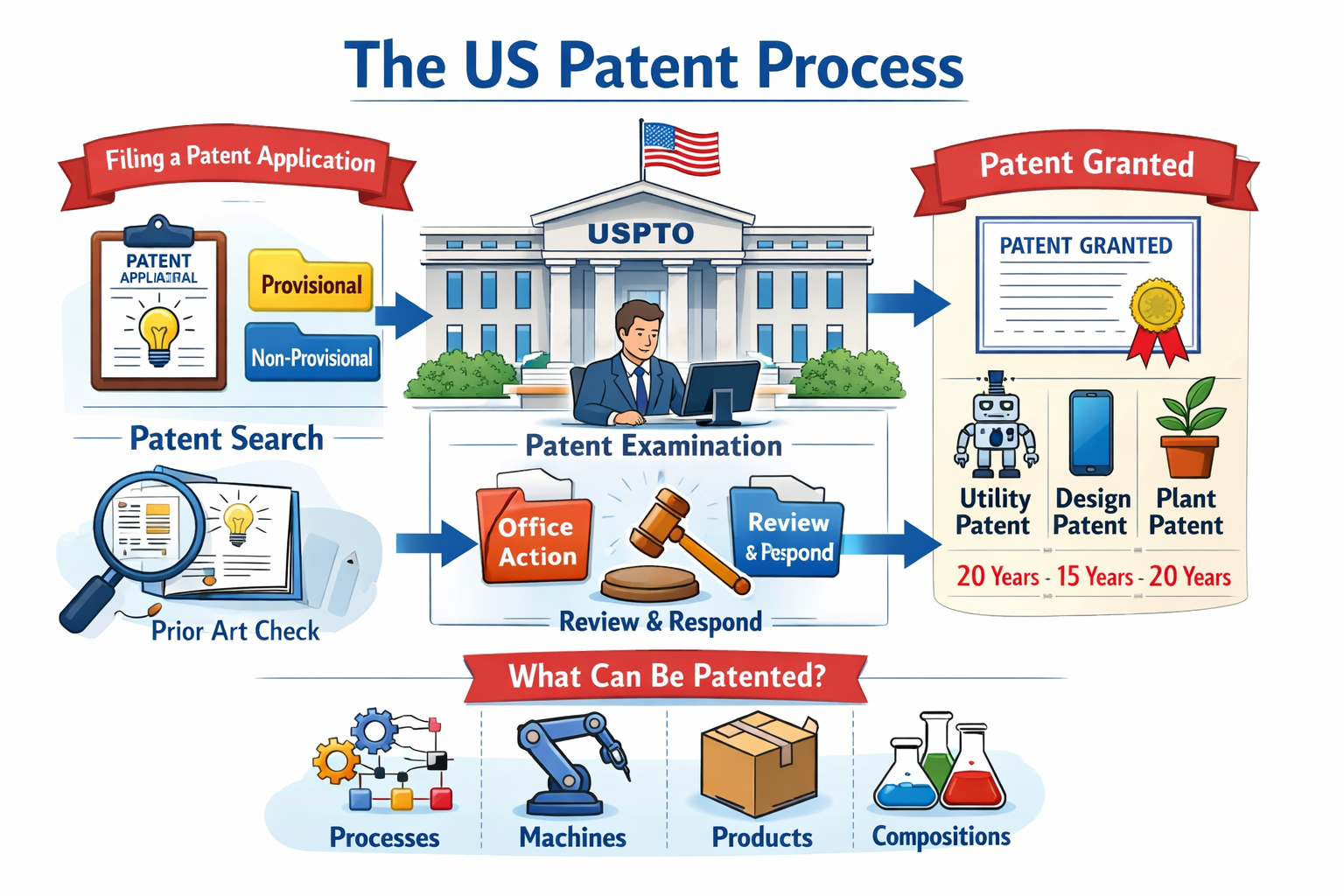
Step 4: File the Application
Inventors can file either:
- Provisional Application: A temporary filing that secures an early priority date. It lasts 12 months.
- Non-Provisional Application: The formal application that begins examination.
Strong applications include detailed descriptions, claims, and drawings. Poor drafting often leads to rejection.
Step 5: Examination by USPTO
A patent examiner reviews the application. They compare it with existing inventions and assess compliance with legal standards.
Examiners often issue Office Actions, which may include objections or rejections. Applicants must respond quickly and strategically.
This phase is critical. Clear arguments and amendments can make or break approval.
Step 6: Grant and Maintenance
Once approved, the USPTO grants the patent. However, the process does not end there.
Utility patent holders must pay maintenance fees to keep their rights active. Failure to pay can result in early expiration.
How Long Does a Patent Last?
Patent duration depends on the type of protection. Each category serves a different purpose and offers a different lifespan.
- Utility Patents: Last 20 years from the filing date.
- Design Patents: Last 15 years from the grant date.
- Plant Patents: Last 20 years from the filing date.
This difference creates a clear contrast. Functional inventions receive longer protection, while aesthetic designs receive shorter but still meaningful coverage.
What Can Be Patented?
The U.S. patent system supports a wide range of innovations. However, it draws a sharp line between true inventions and abstract concepts.
Patentable Subject Matter
Inventors can patent:
- Processes (industrial or technical methods)
- Machines (devices and systems)
- Manufactured products
- Chemical compositions and pharmaceuticals
These categories form the backbone of industrial innovation.
Non-Patentable Subject Matter
Certain ideas remain outside the patent system:
- Abstract ideas
- Laws of nature
- Natural phenomena
- Pure mathematical formulas
This distinction ensures that fundamental knowledge remains accessible to all.
Types of Patents in the U.S.: A Comparative View
Understanding patent types helps inventors choose the right protection strategy.
Utility Patents: The Powerhouse
Utility patents dominate the system. They protect how an invention works.
Examples:
- Software algorithms with technical applications
- Medical devices
- Mechanical tools
Strengths:
- Broad protection
- Long duration (20 years)
Limitations:
- Complex application process
- Higher cost
Design Patents: The Visual Shield
Design patents protect how an invention looks, not how it functions.
Examples:
- Smartphone shapes
- Product packaging
- User interface designs
Strengths:
- Faster approval
- Lower cost
Limitations:
- Narrow protection
- Covers appearance only
Plant Patents: The Niche Protector
Plant patents apply to new plant varieties that are asexually reproduced.
Examples:
- Hybrid flowers
- Genetically developed crops
Strengths:
- Specialized protection
- Supports agricultural innovation
Limitations:
- Limited scope
- Niche application
Key Differences at a Glance
| Feature | Utility Patent | Design Patent | Plant Patent |
|---|---|---|---|
| Focus | Function | Appearance | Plant variety |
| Duration | 20 years | 15 years | 20 years |
| Complexity | High | Moderate | Moderate |
| Common Use | Technology, pharma | Consumer products | Agriculture |
This comparison highlights a clear divide. Utility patents deliver depth. Design patents deliver speed. Plant patents serve a specialized purpose.
Why Patents Matter More Than Ever
Patents do more than protect ideas. They drive economic growth.
Companies use patents to:
- Secure market dominance
- Attract investors
- License technology for revenue
- Block competitors
In industries like pharmaceuticals and technology, patents often determine success or failure.
For startups, a strong patent can be the difference between funding and failure. For large corporations, patent portfolios act as strategic weapons.
Final Takeaway
The U.S. patent system offers a powerful framework for protecting innovation. However, it demands precision, patience, and strategy.
From filing to approval, every step carries weight. Choosing the right patent type, drafting strong claims, and responding effectively to examiners can define the outcome.
In a world where ideas move fast, patents ensure that inventors stay ahead. They transform creativity into tangible value. And most importantly, they reward those who dare to innovate.