
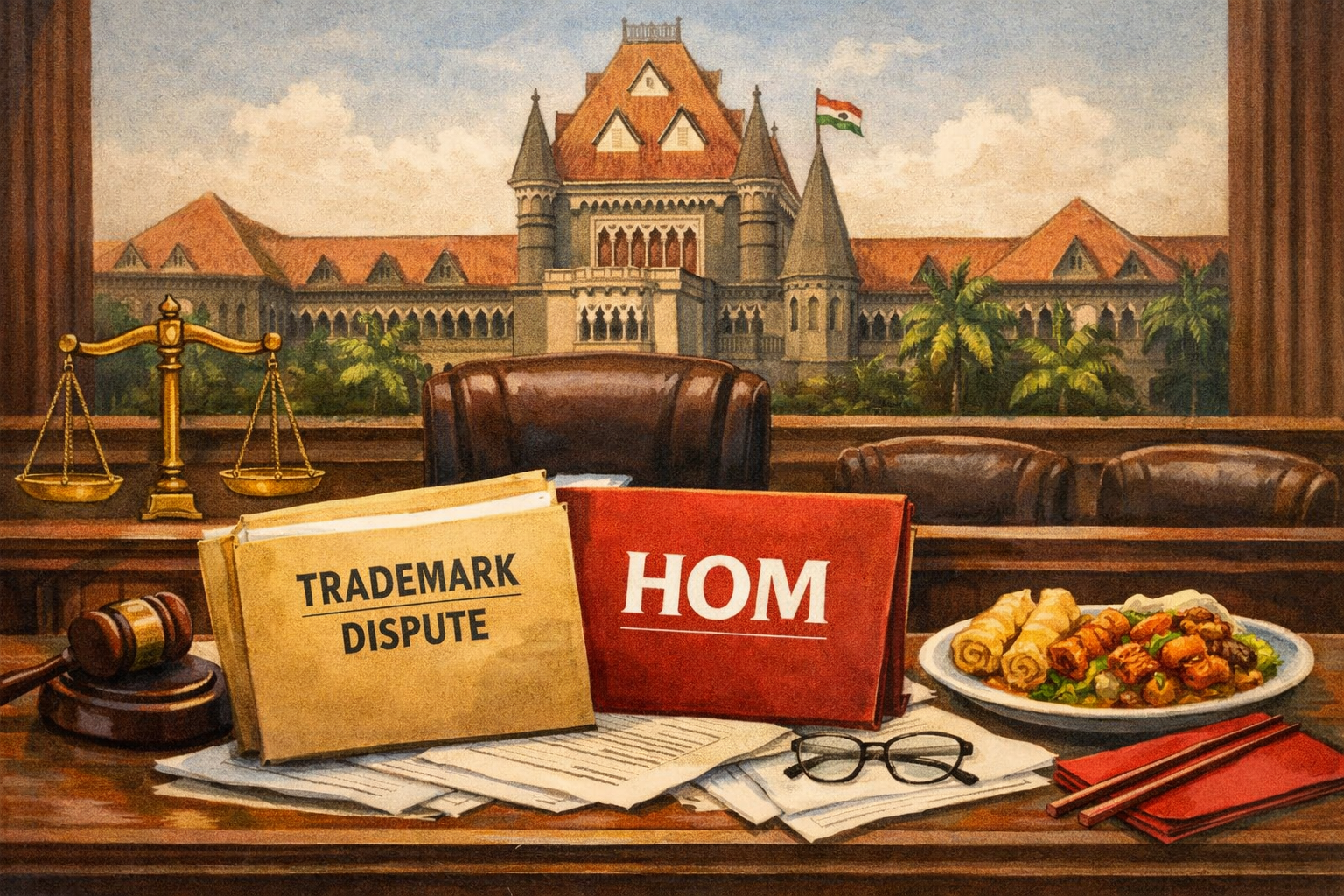
The Bombay High Court has refused to grant interim relief to the Chinese cuisine restaurant House of Mandarin in a trademark dispute involving the use of the acronym “HOM.” The court ruled that the restaurant failed to establish a strong prima facie case of trademark infringement or passing off. The decision highlights the strict legal standards applied in intellectual property disputes, especially those involving abbreviations and acronyms.
Justice Sharmila U. Deshmukh, who heard the matter, delivered the order on December 19, 2025. The judge held that House of Mandarin did not provide sufficient evidence to show that “HOM” had acquired a distinctive identity exclusively linked to its business. As a result, the court declined to restrain the rival restaurant from using the acronym at this stage.
Background of the Dispute
House of Mandarin operates as a Chinese restaurant in Mumbai and has built a presence in the city’s competitive food and beverage market. The restaurant filed a civil suit alleging trademark infringement and passing off against another restaurant that used the acronym “HOM” in its branding.
The plaintiff argued that customers, food critics, and regular patrons commonly refer to House of Mandarin as “HOM.” It claimed that the acronym had become a shorthand identifier of its brand. According to the restaurant, the rival’s use of the same acronym created confusion among consumers and diluted its goodwill.
The restaurant therefore sought an interim injunction. It asked the court to immediately restrain the defendant from using “HOM” until the final disposal of the suit.
Court’s Assessment of the Claim
The Bombay High Court carefully examined whether the plaintiff met the legal requirements for interim relief. Under trademark law, a party seeking such relief must prove three elements. These include a strong prima facie case, the likelihood of irreparable harm, and a balance of convenience in its favor.
Justice Deshmukh found that House of Mandarin failed at the very first stage.
The court observed that the restaurant did not establish that “HOM” had acquired an independent and distinctive reputation in the market. While the acronym may be used informally, the judge noted that informal references alone do not automatically create trademark rights.
The court also examined how the restaurant presents itself commercially. It observed that on popular food delivery platforms and menus, the business appears prominently under its full name, House of Mandarin. The acronym “HOM” does not function as the primary public-facing identifier of the restaurant.
This weakened the claim that consumers strongly associate “HOM” with the plaintiff alone.
Failure to Prove Consumer Confusion
A key element in trademark infringement and passing off cases is consumer confusion. The court stressed that the plaintiff must show that an average consumer is likely to be misled into believing that the rival’s business is connected with the plaintiff.
In this case, the court found no convincing evidence of such confusion.
The judge noted that restaurants typically attract informed customers who make deliberate choices. Dining decisions often involve reviewing menus, locations, prices, and brand identities. In such circumstances, the likelihood of confusion based solely on an acronym becomes lower.
The plaintiff did not present consumer surveys, complaints, or documented instances of mistaken identity. In the absence of such material, the court said it could not presume confusion.
Passing Off Claim Not Established
The court also examined the claim of passing off. To succeed in a passing off action, a plaintiff must prove goodwill, misrepresentation, and damage.
Justice Deshmukh acknowledged that House of Mandarin may enjoy goodwill under its full name. However, she clarified that goodwill in a full brand name does not automatically extend to an abbreviation unless the abbreviation has independently acquired recognition.
The court found no evidence to show that the rival restaurant misrepresented its services as being associated with House of Mandarin. There was also no material to demonstrate actual or imminent damage to the plaintiff’s business.
As a result, the passing off claim did not justify interim protection.
Defendant’s Position
The defendant restaurant argued that it used “HOM” independently and legitimately. It denied any intention to exploit the reputation of House of Mandarin. The defendant maintained that its branding, presentation, and customer base were distinct.
At the interim stage, the court accepted that the defendant’s use did not appear deceptive on the face of the record. The judge stated that these issues would require deeper examination during trial.
Legal Threshold for Interim Injunctions
The High Court reiterated that interim injunctions are extraordinary remedies. Courts must exercise caution before restraining a business from operating under its chosen name.
Justice Deshmukh emphasized that trademark rights over abbreviations demand strong proof. A party must demonstrate long, consistent, and prominent use of the acronym as a standalone brand. Without this, courts are unlikely to grant immediate relief.
The judge clarified that the refusal of interim relief does not decide the final rights of the parties. It only reflects the court’s view that the plaintiff did not meet the high threshold required at this early stage.
What the Ruling Means
With this order, House of Mandarin cannot prevent the rival restaurant from using “HOM” for now. The main suit will continue, and both sides will have the opportunity to present detailed evidence during trial.
The ruling sends an important message to businesses. It underscores that abbreviations and short forms are not automatically protected under trademark law. Brand owners must actively establish distinctiveness and consumer association if they wish to claim exclusive rights over acronyms.
Legal experts believe the judgment could influence future trademark disputes in the hospitality sector. Restaurants often rely on catchy abbreviations and nicknames. This ruling makes it clear that courts will demand concrete proof before recognizing such claims.
Next Steps in the Case
The case will now proceed to the evidence stage. House of Mandarin may attempt to strengthen its position by submitting additional material. This could include advertising records, media references, customer testimonials, or survey evidence.
The final outcome will depend on whether the restaurant can demonstrate that “HOM” has become a distinctive badge of origin linked solely to its business.
Until then, the Bombay High Court’s order stands as a reminder. Trademark protection depends not on intention or belief, but on proof, perception, and public association.