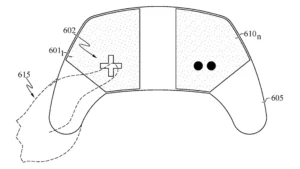
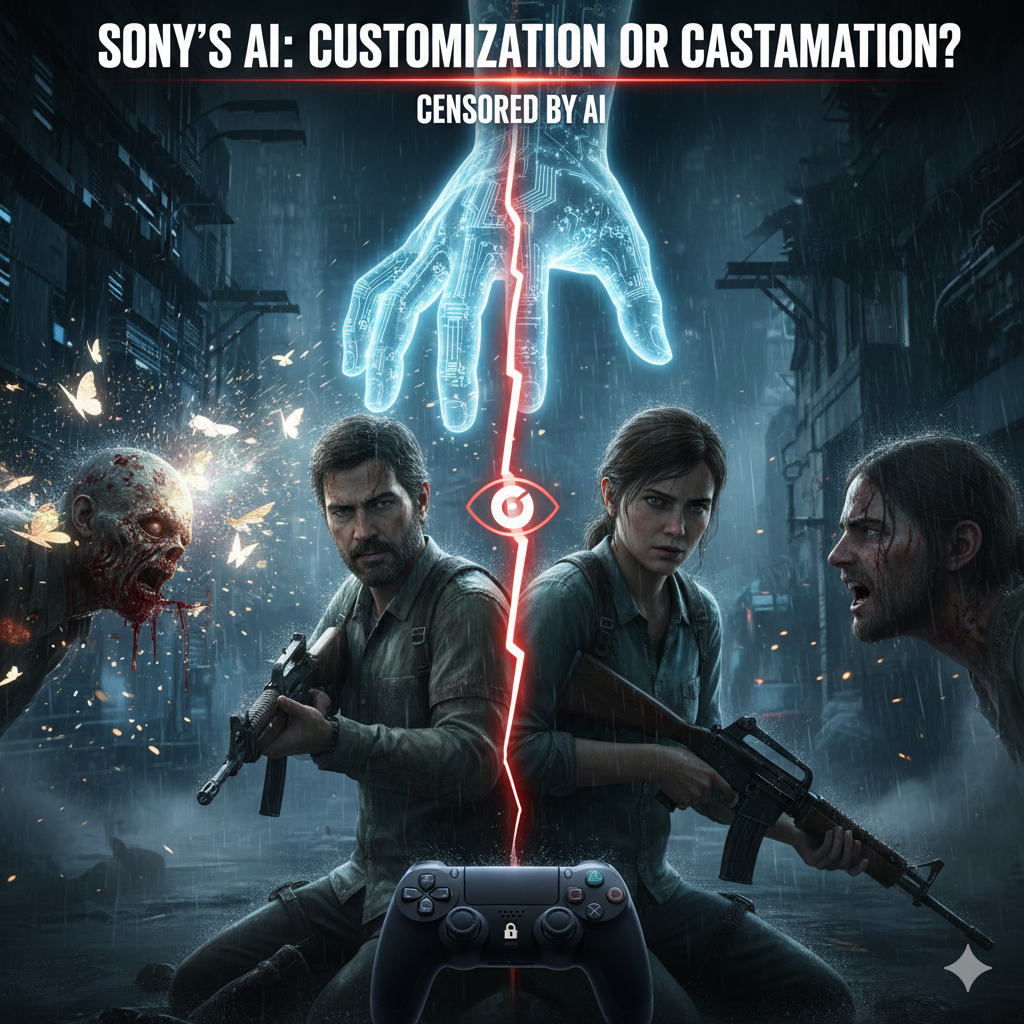
Sony Interactive Entertainment has ignited a firestorm in the gaming world. A newly published patent reveals a future where video games change while you play. This technology uses Artificial Intelligence to edit, blur, or even rewrite digital content on the fly. It is called “Automatic Bespoke Edits of Video Content Using AI.” The implications are massive.
The Mechanics of Instant Modification
Sony’s vision sits between the game engine and your screen. It acts like a high-tech filter. The AI scans every frame of video and every second of audio. It looks for “sensitive” material. This includes gore, sexual themes, and profanity.
The system does not just block a game. It remodels it. If the AI detects a violent execution, it might blur the blood. If a character screams a curse word, the AI mutes the sound. Most shockingly, the patent describes using Deepfakes. The system could replace a severed limb with a harmless object. It could swap a frightening monster for a cartoon character. This happens in milliseconds.
Power to the Parents
Sony frames this as the ultimate safety tool. Traditional age ratings are rigid. A “Mature” rating blocks the entire game from a child. This AI allows for a “middle ground.” * Profiles: Parents can set custom rules for each family member.
- Safety Toggles: Users can choose to hide specific triggers, like spiders or needles.
- Seamless Flow: The game keeps running. There are no abrupt cuts or “black bars.”
For many, this is a dream come true. It lets kids experience the mechanics of a hit game without the adult themes. It gives players control over their own comfort.
The Death of Artistic Integrity?
However, critics are sounding the alarm. They call it “digital sanitization.” Many games are works of art. Developers choose every pixel for a reason. In titles like The Last of Us, violence serves the story. It makes the world feel dangerous.
If an AI scrubs away the grit, does the story lose its soul? Some fear that platform holders like Sony will gain too much power. They could dictate what is “acceptable” across all games. This moves the power from the creator to the algorithm.
A Shadow Over Creativity
The fear extends to the development phase. If studios know an AI will rewrite their work, they might stop taking risks. They might design games for the “lowest common denominator.” This could lead to a future of bland, corporate-approved content.
Furthermore, the technology relies on “sentiment analysis.” AI often struggles with context. It might mistake a character’s grief for “negative content.” It might mute a powerful monologue because of a single intense word. This creates a disjointed and confusing experience for the player.
The Road Ahead
A patent is not a product. Sony files hundreds of ideas every year. Many never see the light of day. But this patent shows a clear direction. Sony wants the PlayStation ecosystem to be the most adaptable platform on Earth.
The gaming community is watching closely. The industry stands at a crossroads. One path leads to unparalleled accessibility and safety. The other leads to a world where “The Player’s Experience” is curated by a machine, not a human. Whether this becomes a tool for protection or a weapon for censorship remains to be seen. For now, the line between a “custom experience” and “altered art” has never been thinner.