
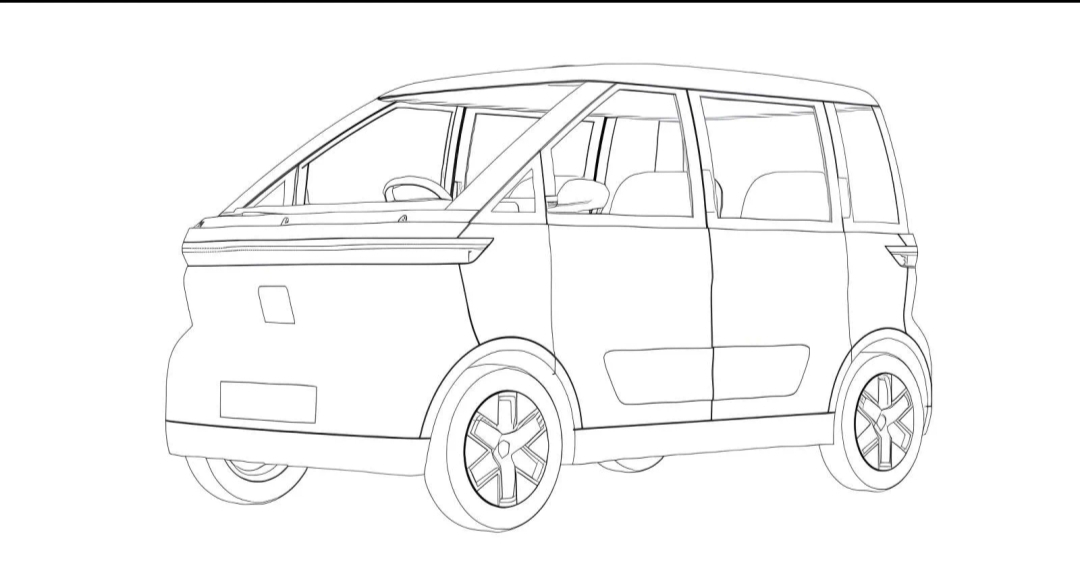
Ola Electric Files Design Patent for Compact Urban EV

Ola Electric appears to be working on a compact electric car as a new design patent surfaces online. The patent hints at a shift in the company’s focus from premium sedans to affordable, urban electric vehicles aimed at mass adoption.

The design, filed in India, showcases a futuristic compact hatchback with short overhangs and a minimalist exterior. The model seems to have a two-row layout and a full-width LED light bar at the front. The overall design suggests a city-friendly car tailored for dense urban environments.

According to reports, the upcoming model will likely use Ola’s Gen 4 platform. This new modular platform can support two-, three-, and four-wheeled electric vehicles. Ola aims to use it for scooters, small cars, and light commercial vehicles.

The company’s in-house developed 4680 Bharat cell could power the car. The locally produced cell promises better energy density and lower cost, helping Ola reduce dependence on imported components. This aligns with Ola’s plan to make India self-reliant in electric mobility technology.

The compact EV marks a clear change in Ola’s product strategy. The firm had earlier teased a sleek performance-oriented electric sedan, but the latest patent shows a move toward the volume-driven small car segment. Industry experts say this decision could open new opportunities in the growing affordable EV market.

If Ola succeeds, it could compete directly with the Tata Tiago EV, MG Comet EV, and Citroën eC3, all positioned below ₹10 lakh in India. A well-priced Ola hatchback with a real-world range of around 200 to 300 km could attract first-time EV buyers and daily city commuters.

However, challenges remain. Manufacturing a car requires large investments in design validation, safety testing, and production infrastructure. Ola’s experience so far lies mainly in electric scooters. Scaling up to four-wheelers will test its technical and operational capabilities.

The company has not confirmed specifications, pricing, or launch timelines yet. But experts expect the first compact EV from Ola to arrive by 2026 or 2027, following the completion of its cell manufacturing facility and platform readiness.

If executed well, the compact EV could become a game-changer for Ola and for India’s electric mobility landscape. With localized batteries, a scalable platform, and an urban-friendly design, Ola Electric might finally bring a truly homegrown electric car to Indian roads.
Huawei Secures Patent to Boost Smartphone Battery Life with Composite Electrode Technology

Huawei has received approval for a new battery technology patent that could significantly improve the performance and lifespan of future smartphones. The patent, titled “Composite Electrode Material and Preparation Method, Lithium Battery, and Electronic Device,” was originally filed in September 2021 and was officially granted this week.

A Smarter Electrode Design

At the heart of this innovation is a composite electrode material wrapped with an organic fiber structure. This design tackles a common challenge in lithium batteries: plastic deformation that occurs when the battery undergoes repeated charging and discharging cycles.

By introducing organic fibers, Huawei’s method enhances the structural stability of the electrode. This not only minimizes deformation but also improves adhesion within the material through a chemical interaction known as the CONH group. In simple terms, the battery becomes more resistant to wear and tear, allowing it to last longer without losing efficiency.

Extending Smartphone Battery Life

Battery performance remains one of the top concerns for smartphone users. While hardware and software optimizations have helped in recent years, physical degradation of battery materials still limits overall lifespan.

Huawei’s new approach aims to directly strengthen the electrode layer, meaning future smartphones could enjoy:

  • Longer battery lifespan with reduced capacity loss over time.
  • Higher reliability during extended usage.
  • Better performance retention, even after hundreds of charging cycles.

This patent builds on Huawei’s ongoing research into next-generation energy storage. The company has previously explored advanced graphene batteries and fast-charging technologies, signaling a broader strategy to lead in smartphone power solutions.

Industry Implications

Huawei’s development comes at a time when global smartphone makers are racing to deliver safer, longer-lasting batteries. With Apple and Samsung investing heavily in solid-state battery research, Huawei’s focus on composite electrode materials provides another possible path toward breakthroughs in energy storage.

If commercialized, this technology could reduce the frequency with which consumers replace their smartphones due to degraded batteries. It also aligns with global trends in sustainable technology, where improving efficiency helps lower electronic waste.

What’s Next

Although the patent has been approved, Huawei has not yet confirmed when this battery technology will appear in commercial products. Given the increasing competition in the premium smartphone market, industry watchers believe Huawei could integrate it into upcoming flagship models to gain a performance edge.

For now, the approval highlights Huawei’s strategic investments in core hardware innovation—an area the company continues to prioritize despite challenges in global markets.


🔗 External References: