
Godavari Biorefineries Secures US Patent for Cancer-Fighting Compounds; Stock Soars

Godavari Biorefineries Limited (GBL) has achieved a major scientific and strategic breakthrough. The company has secured a United States patent for a new class of cancer-fighting compounds designed to inhibit unregulated cell growth. These compounds show strong potential against cancer stem cells, a highly resistant category of cancer-driving cells.

The announcement sparked immediate excitement in the market. GBL’s stock surged nearly 17–18% in early trade as investors responded to what could become a transformative development for the company and for cancer research in India. The rally underscores growing investor confidence in the company’s expanding biotechnology capabilities.


A closer look at the patented science

The patented invention, titled “Compounds for the Inhibition of Unregulated Cell Growth,” gives GBL exclusive rights in the United States to produce, license, and commercialize the molecules.

According to the patent filing, the compounds demonstrate targeted action against cancer stem cells (CSCs). This is a small but powerful subset of tumour cells that fuel the growth, recurrence, and spread of cancer. CSCs are often responsible for treatment resistance, which is why many cancers return even after chemotherapy or radiation.

The patent includes compounds listed across multiple novel chemical formulae. Laboratory studies indicate promising results against breast and prostate cancer cell lines. These two cancer types remain among the most prevalent globally, making the discovery especially significant.

What makes the patented approach compelling is its precision. Traditional anti-cancer treatments target rapidly dividing cells, but they often miss slow-dividing or dormant CSCs. By attacking the core drivers of tumour regeneration, these molecules could one day lead to therapies that significantly reduce relapse rates.


A growing global footprint in cancer innovation

The US patent builds on GBL’s accelerating global presence in advanced cancer research. Earlier this year, the company secured a European patent for a similar anti-cancer molecule. The validation extended across Spain, the United Kingdom, and several European Union member nations, boosting the company’s intellectual-property coverage across major regulatory regions.

The company also received a Chinese patent earlier this year for another breakthrough anti-cancer compound known for inhibiting cancer cell proliferation and targeting CSCs. Preclinical research highlighted its strong activity against breast and prostate cancer lines, adding another high-value asset to its growing research portfolio.

To support its expansion, GBL has also established a dedicated subsidiary in the United States. This move positions the company to engage directly with the world’s largest pharmaceutical market and collaborate with global research institutions and biotech partners.


Why this matters: opportunities on the horizon

A breakthrough for Indian bioresearch

Securing a US patent in the oncology domain is a rare achievement for an Indian company. It signals that GBL is not just a leader in the biorefinery and biofuel sectors but is evolving into a serious contender in medical biotechnology.

Promising pathway toward targeted therapies

If future research validates the patented molecules, they could form the foundation for next-generation cancer drugs that destroy tumour-regenerating cells. Targeting CSCs represents one of the most ambitious goals in cancer science. Successful therapies in this space could dramatically reshape cancer treatment outcomes.

Attractive for global collaborations

The company’s expanding patent portfolio across three major regions — the US, Europe, and China — places it in a powerful position. Pharmaceutical giants often seek partnerships with early-stage innovators who hold strong patents. GBL could attract licensing deals, co-development agreements, or investment partnerships as its molecules advance.

Market confidence and investor traction

The sharp rise in the stock price reflects more than short-term excitement. Investors see growing scientific depth, diversified business potential, and long-term value creation opportunities driven by high-impact IP.


The challenges ahead: long journey to the clinic

Despite the breakthrough, the patented molecules are still in early-stage development. A patent protects the innovation, but it does not guarantee clinical success.

To become approved cancer therapies, the compounds must pass through multiple stages:

  • Preclinical safety testing
  • Toxicology assessments
  • Pharmacokinetics and pharmacodynamics studies
  • Phase I, II, and III human trials
  • Regulatory approvals in each market

Oncology drug development is expensive and time-intensive. Success rates are low, and many promising compounds fail due to toxicity or lack of efficacy. GBL may require strategic partnerships, research collaborations, or significant investment to advance the molecules through clinical trials.


A milestone moment — and the beginning of a new chapter

Godavari Biorefineries’ US patent win marks a bold moment for Indian innovation. The company is rapidly expanding beyond its traditional identity as a biorefinery pioneer. With patents across the world’s largest markets, GBL is positioning itself as a future player in global oncology research.

If the science progresses well, this breakthrough could transform not only the company’s trajectory but also contribute to a new generation of targeted cancer therapies. The recognition, the rising investor confidence, and the global IP strategy together point to a powerful new chapter in India’s biotech evolution.

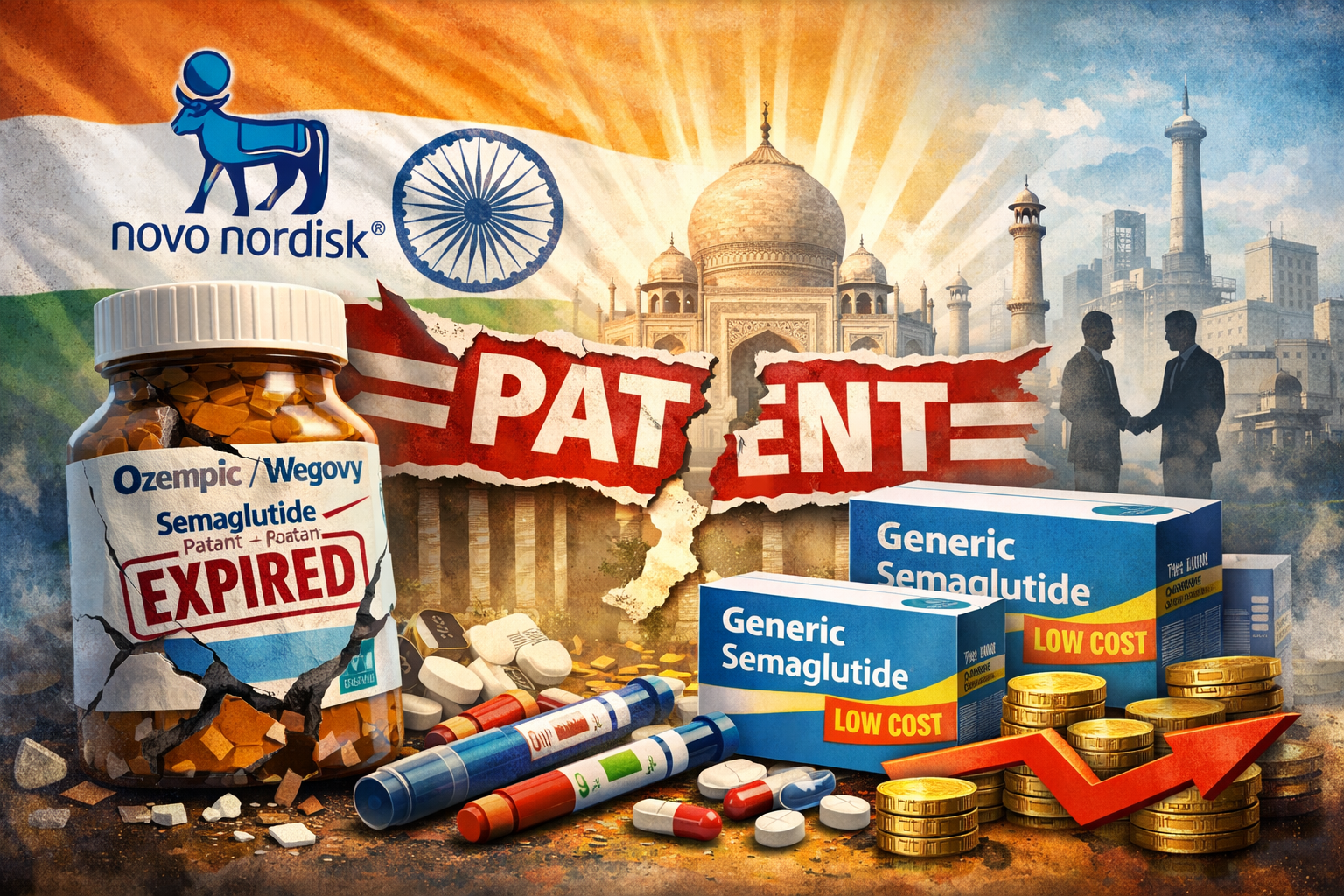
Delhi High Court Rejects Interim Patent Block on Semaglutide, Calls Out ‘Evergreening’ Tactics

The Delhi High Court has delivered a decisive order in the high-stakes battle over semaglutide, the blockbuster diabetes and weight-loss drug. The court refused to grant Novo Nordisk a temporary injunction against Dr Reddy’s Laboratories (DRL), dealing a major blow to the Danish pharmaceutical giant’s attempt to control the Indian market until 2026. The ruling carries far-reaching implications for patent strategy, market competition, and the future of GLP-1 drugs in India.

The court held that DRL had raised a “credible challenge” to Novo Nordisk’s second patent on semaglutide. It found strong indicators of double-patenting, a practice that Indian law treats as an attempt to “evergreen” expired monopolies. The court’s message was clear: companies cannot use secondary patents to prolong control over blockbuster drugs.


Two Patents, One Molecule: How the Dispute Began

Novo Nordisk held two Indian patents related to semaglutide:

  1. Composition Patent (IN 275964)
    This patent covered the semaglutide molecule itself. It expired in September 2024, opening the door for generic manufacturing.
  2. Formulation Patent (IN 262697)
    This patent claims a specific formulation and delivery system for the same drug. It remains valid until March 2026.

When the core composition patent lapsed, DRL secured regulatory approval from the Central Drugs Standard Control Organization (CDSCO) to manufacture semaglutide for export. The approval triggered immediate friction. Novo Nordisk rushed to court, claiming that the formulation patent protected not only the delivery mechanism but effectively covered the drug.

It sought an emergency injunction to stop DRL’s manufacturing and export operations. The company argued that any commercial activity—even export—would cause irreparable harm.


The Court’s Ruling: A Firm Stand Against Evergreening

Justice Anish Dayal rejected the injunction request. The court held that DRL’s objections to the formulation patent were strong enough to deny temporary relief to Novo Nordisk.

1. Double-Patenting Concern

The court noted that the formulation patent appeared to reclaim the same invention for which Novo Nordisk’s composition patent had already expired. The claims overlapped heavily.

This amounted to “evergreening”—a tactic where pharmaceutical companies file secondary patents to extend monopoly periods.

Indian patent law, especially after Section 3(d), firmly discourages such strategies.

2. Lack of Inventive Step

The court observed that Novo Nordisk’s claimed improvements in the formulation patent did not appear novel or non-obvious.
The modifications were routine optimizations well known in pharmaceutical science. They did not represent a genuine leap in innovation.

This significantly weakened the validity of the formulation patent.

3. Balance of Convenience Favoured DRL

Since the core patent had expired, the court held that public interest and market competition must be prioritized.

Blocking DRL without conclusive proof of infringement would be unfair, especially when DRL was manufacturing the drug only for export markets.


Exports Allowed, But Indian Market Stays Closed—for Now

The court made a nuanced distinction. DRL may:

  • continue manufacturing semaglutide, and
  • export it freely to international markets.

However, domestic sales remain prohibited until the formulation patent expires in March 2026, unless the patent is invalidated earlier.

This split ruling reinforces India’s position as the world’s largest exporter of affordable generics, while still respecting valid patent rights inside the country.


A Major Win for Generic Manufacturers

The decision strengthens the confidence of Indian pharmaceutical companies entering high-value therapeutic categories. Semaglutide, widely used for Type-2 diabetes and explosive global demand for weight-loss treatments, represents one of the most lucrative drug classes today.

DRL is not alone. Cipla, Sun Pharma, Biocon, and Mankind Pharma are exploring GLP-1 opportunities. The Delhi HC’s ruling sends a bold signal: secondary patents will face strict scrutiny.

Indian courts have repeatedly warned against evergreening. This judgment continues that legacy, following similar rulings in the cases of imatinib, sofosbuvir, and darunavir.


Why This Case Matters Globally

The global pharmaceutical industry is watching India closely. Semaglutide is one of the world’s most valuable drugs, powering Novo Nordisk’s meteoric rise in recent years.

A single ruling from an Indian court can influence:

  • global supply chains,
  • generic entry timelines,
  • price dynamics across continents.

India produces nearly 40% of the world’s generics. Any shift in the patent landscape here disrupts international markets.

By allowing export manufacturing, the court has opened a potential pipeline of affordable semaglutide to emerging markets struggling with diabetes and obesity crises.


What Happens Next?

Novo Nordisk has several options:

  • Appeal before a division bench of the Delhi High Court.
  • Initiate a full trial to defend the validity of the formulation patent.
  • Seek tighter regulatory restrictions on generic manufacturing.

DRL, meanwhile, may accelerate export production and explore challenging the patent’s validity to unlock the domestic market earlier.

Legal experts expect this case to set an important precedent for future GLP-1 patent disputes, especially as rival companies race to launch their own weight-loss drugs.


Conclusion

The Delhi High Court’s rejection of Novo Nordisk’s interim injunction is a striking affirmation of India’s sharp stance against patent evergreening. The ruling protects open competition, enables affordable access through exports, and reinforces India’s leadership in generic pharmaceuticals.

As demand for semaglutide surges worldwide, the judgment could reshape the global supply chain for one of modern medicine’s most influential drug classes.

The Patent Paradox: Why India’s Startup Filing Surge is 83% Failure and All About Optics

Fragile gold patent scroll on a precarious foundation, with the number 83% failure rate overlaid, symbolizing the optical illusion of India's startup patent filing surge.

A deep dive into the intellectual property (IP) landscape of India’s booming startup sector reveals a critical gap between ambition and execution, suggesting that the much-lauded surge in patent filings is predominantly a tactical exercise in investor signalling rather than a genuine marker of technological innovation. The core issue, critics argue, is a “crisis of intent” where patents function as “decorative rather than functional” assets.   

While global bodies like the World Intellectual Property Organization (WIPO) have celebrated India’s rapid ascent—the WIPO 2024 report noted a phenomenal 15.7% growth in patent applications in 2023, positioning the country 6th globally with 64,480 filings —the internal data paints a sobering picture of weak follow-through.   

The Data Gap: 83% of Startup Patents Fail to Secure a Grant

Analysis of the startup patent pipeline from 2021 through 2025 reveals a profound drop-off rate, demonstrating that the vast majority of filings are not carried through to completion.   

During this five-year period, Indian startups filed a robust 13,089 patent applications. Yet, only 2,174 of these successfully navigated the examination process to achieve the grant stage. This results in a grant success rate of barely 16.6%, meaning approximately one out of every six startup filings becomes an enforceable, proprietary asset.   

The failure rate is compounded by active abandonment. Nearly 500 startup patent applications were explicitly withdrawn or abandoned early, often due to the filers failing to complete detailed specifications or respond to subsequent office actions required by the Patent Office.   

This pattern extends beyond patents. Startups filed 44,517 trademark applications during the same period, with over 1,300 subsequently abandoned. Analysts suggest this widespread non-prosecution across IP types confirms that the primary function of the filing is “brand optics” rather than a rigorous, long-term IP strategy. The high volume of dropped applications confirms that for many, the intent was temporary and instrumental: the patent filing was merely a transaction used to secure funding, not an investment in an enduring intellectual asset.   

Investor Mandate: Patents as Pitch Deck Tools

The distortion in filing behaviour is traced back to the venture capital (VC) ecosystem’s preference for strong valuation narratives. In competitive fundraising rounds, a pending patent application, particularly a cheap and fast provisional filing, serves as a high-visibility proxy for technological differentiation and market moat potential.   

A provisional patent application, which secures an immediate priority date, is leveraged as a “fast, affordable way to strengthen a fundraising narrative” and “create the appearance of a breakthrough innovation”. This mechanism enables a “Capital first, commitment later” ethos.   

The systemic issue is rooted in the fact that investors often prioritize the inclusion of an IP slide over demanding proof of prosecution commitment or demonstrated R&D investment. As the analysis notes, “Once the funding round closes, priorities may shift,” leading to a predictable loss of enthusiasm for the labour-intensive and expensive work required to turn provisional filings into complete specifications. This rational response by founders—underinvesting in expensive, long-term R&D in favour of cheap, high-volume filing tactics—systematically shifts resources away from core innovation.   

Structural Deficiency: India’s R&D Investment Stagnation

The crisis of intent at the startup level is underpinned by a deep, structural R&D deficit at the national level. The commitment to deep, foundational research necessary to generate truly novel and patentable inventions remains structurally low in India.   

Official data from the Department of Science & Technology (DST) confirms that India’s Gross Expenditure on Research and Development (GERD) as a percentage of GDP stood at 0.64% during the fiscal year 2020–21, having remained stagnant between 0.6% and 0.7% in the preceding years (0.66% in 2018–19 and 2019–20).   

This figure is significantly “below global average and lower than countries like China, South Korea and US”. This structural weakness is compounded by low private sector contribution, which accounted for only 36.4% of the total GERD in 2020–21, in sharp contrast to innovation-leading nations where private industry drives over 70% of R&D expenditure.   

This macro-level underinvestment directly correlates with the micro-level deficiencies, as most startups lack “dedicated research teams, technical drafting expertise, prior-art assessment systems, and time for iterative processes” necessary for rigorous patent prosecution.   

Policy Flaw: Incentives Reward Filing, Not Granting

Current government policies designed to stimulate IP activity, while successful in boosting filing volume, have inadvertently intensified the focus on volume over quality. The government successfully implemented significant fee concessions, including an 80% reduction in patent filing fees for startups, MSMEs, and educational institutions.   

However, the design flaw is that these incentives are tied to the input stage (filing) rather than the output stage (grant or commercialization). By heavily subsidizing the initial filing, the state inadvertently subsidizes the creation of the fundraising narrative for VCs. Once the provisional application is lodged, the startup has secured its priority date and the narrative benefit, but the subsequent costly work of prosecution remains unassisted, cementing the low-commitment behaviour.   

Blueprint for Genuine Innovation: Shifting from Decoration to Depth

To foster genuine innovation and correct the systemic inefficiencies, experts advocate for a strategic overhaul of incentives and infrastructure.   

  • Realign Incentives: Government benefits, including subsidies and fast-track examination provisions, must be decoupled from the act of filing and strategically tied to demonstrable outcomes, such as patent grants, successful long-term renewal, or demonstrable commercial utilization.   
  • Enhance Capacity: Urgent investment in the Patent Office is mandatory, including expansion of examiner capacity and specialized domain expertise. There is a pronounced need for more technically specialized patent officers, particularly in cutting-edge technological areas like AI, biotech, semiconductors, climate-tech, and advanced manufacturing.   
  • Strengthen R&D Culture: The government should offer targeted, co-funded grants and innovation-linked incentives for startups that demonstrate a commitment to establishing and maintaining dedicated R&D teams or formalized collaboration with research institutions.   
  • Promote Co-patenting: Actively promoting policy frameworks that encourage joint patent filings (co-patenting) between startups and premier academic/research institutions, such as the IITs and national labs, would guarantee a higher technical standard for the filings and create structured pathways for knowledge transfer.   

The conclusion remains clear: for India to genuinely transition from an IP volume leader to a global innovation power, the focus must shift from decorative filings to functional intellectual assets. Only then can “depth replace decoration” and solidify India’s reputation as a serious, quality-driven innovation hub.   

Fitterfly Patent Victory: AI-Driven PGR Tech Secures IP, Revolutionizes Diabetes Care in India

Fitterfly PGR technology patent diagram showing AI analysis of CGM data for diabetes outcomes

Digital health just scored a decisive victory. Fitterfly, the pioneering digital therapeutics arm of PB Health, secured a crucial Government of India patent. This patent protects its proprietary Personalised Glycemic Response (PGR) technology. The move cements Fitterfly’s dominant position. It dramatically alters the future of chronic disease management in India.

AI Engine Powers Precision Care

The patent covers the core of Fitterfly’s diabetes program. This AI-led engine is the PGR technology. It allows data-driven care at massive scale. PGR helps millions manage diabetes better. It predicts how specific foods and activities impact blood sugar. It makes this prediction up to three hours in advance.

This prediction power is a game-changer. It removes the daily burden of food decisions for patients. PGR moves far beyond standard, generic advice.

The model boasts a huge training dataset. It analysed over 10 lakh (1 million) Continuous Glucose Monitoring (CGM) data points. It studied over 1.21 lakh individual meals. The algorithm factors in every critical metric. These include age, BMI, heart rate, sleep, and co-morbidities. This process delivers highly accurate, personalised glucose predictions.

Clinical Outcomes Prove Efficacy

The technology already boasts unmistakable clinical success. Over 40,000 members have benefited from the PGR-powered programs. The results are clinically significant, matching high-grade pharmaceutical interventions.

In 2025, 94% of members with very high baseline HbA1c levels (above 9%) saw massive improvement. They recorded an average reduction of 2.8 points within 6 to 12 months. This outcome is comparable to standard multi-drug regimens.

Furthermore, Fitterfly’s data confirms that diabetes remission is possible. It applies to a large number of Type 2 Diabetes cases, particularly in the early stages. The program also delivers holistic health gains. Members improved critical markers. These include reduced serum cholesterol, lower triglycerides, and better blood pressure control. This success transforms patients’ quality of life. It substantially reduces future complication risks.

Dr. Vineet Nair, Head of Program Design at Fitterfly, affirmed the approach. “PGR helps us go beyond standard protocols,” he said. “It delivers care that adapts to each member’s data. This drives better adherence. It guarantees improved glucose control and more consistent progress.”

Patent Builds a Commercial Fortress

The patent acquisition is a legal triumph. It gives Fitterfly a formidable fortress of Intellectual Property (IP).

The Government of India approval confirms the unique nature of the PGR algorithm. It grants Fitterfly exclusive commercial rights. This protection shields the company from direct competition. It also exponentially increases PB Health’s valuation. The technology shifts from a service model to a protected, scalable asset.

Dr. Arbinder Singal, Head of Preventive and Digital Health at PB Health and Co-founder at Fitterfly, emphasized the strategic importance. “Our proven outcomes and proprietary technology add significant value,” he stated. “The patent secures the technical core of our chronic disease management offering.”

The move reinforces PB Health’s vision. They aim to create a tech-first, integrated healthcare ecosystem. Fitterfly’s digital expertise becomes the crucial preventative arm. This balances PB Health’s growing hospital network in the Delhi-NCR region.

India’s Health System Faces Transformation

Chronic conditions devastate India’s population. Nearly 40 percent of Indian adults suffer from diabetes, hypertension, or obesity. This is an immense, growing crisis.

Technology like PGR offers the only viable path to scale positive change. It empowers patients, doctors, and insurers alike.

For Insurers: Diabetes remains the biggest cost driver. Fitterfly’s outcome-led programs offer a clear solution. They reduce the risk of progression and expensive hospitalizations. Several leading insurance companies already recognize this shift. They integrate Fitterfly’s programs into their policyholder ecosystem. This acts as a proactive risk management measure. It lowers long-term claims.

For Patients: PGR grants control. It is a fundamental shift from reactive treatment. It establishes continuous, outcome-led management. This approach improves long-term disease stability. It leads to huge cost savings and boosts work productivity.

Dr. Singal added, “We are working closely with leading insurers. We are shifting the focus from treatment to long-term health stability. This is a crucial step. It builds a more sustainable, future-ready healthcare model for India.”

The successful patenting of PGR technology marks a definitive moment. It confirms that Digital Therapeutics (DTx) is not a supplement. DTx is becoming the first line of defence against India’s escalating chronic disease epidemic. This victory is a resounding signal. Personalised, AI-driven healthcare is now locked in. It is set to dominate the market.