Tesla is rewriting the rules of connectivity. A bombshell patent filing reveals a future where dead zones vanish. Elon Musk is merging his two greatest empires: Tesla and SpaceX. The goal is simple. Total global dominance through satellite-integrated vehicles.
For years, drivers faced a digital wall. Metal car roofs act like cages. They block signals. They kill high-speed data. Tesla’s new patent, published on December 4, 2025, shatters that wall. It introduces a revolutionary “Radio Frequency Transparent” roof. This is not just a sunroof. It is a gateway to the stars.
The Death of the Dead Zone
Connectivity is the lifeblood of the modern electric vehicle. Tesla relies on data. It needs data for Autopilot. It needs data for over-the-air updates. It needs data for the massive screens inside the cabin. Today, that data comes from cellular towers.
But towers have limits. They fail in mountains. They disappear in deserts. They collapse during natural disasters. This is a fatal flaw for a self-driving future. A Robotaxi cannot lose its mind in a tunnel or a rural valley. It must stay awake. It must stay connected.
Tesla’s solution is the Starlink antenna. By burying these receivers directly into the car’s roof, Tesla creates a permanent link to the SpaceX constellation. This is “always-on” internet. It works in the middle of a hurricane. It works in the heart of the Sahara.
The Engineering Miracle: Hidden in Plain Sight
Traditional satellite dishes are ugly. They are bulky. They ruin aerodynamics. Tesla refuses to sacrifice style. The new patent describes a multi-layered sandwich of high-tech polymers.
Engineers are using Polycarbonate (PC) and Acrylonitrile Styrene Acrylate (ASA). These are not standard plastics. These materials offer the strength of steel. They offer the clarity of glass. Crucially, they allow radio waves to pass through like ghosts.
The antenna sits beneath this skin. It is invisible to the eye. It is perfectly aerodynamic. It adds zero drag. This engineering feat allows Tesla to maintain its sleek, futuristic silhouette while housing the most powerful communication tool on Earth.
Powering the Robotaxi Revolution
Why does this matter now? The answer is autonomy. Tesla is betting everything on the Robotaxi. These autonomous fleets require massive bandwidth. They need real-time HD maps. They need constant communication with a central command.
A cellular glitch could paralyze an autonomous fleet. Starlink removes that risk. It provides a redundant, high-speed backbone. If the 5G network fails, the car switches to space. This seamless handoff ensures safety. It ensures reliability. It makes Tesla the only car company capable of operating truly anywhere.
An Entertainment Powerhouse
The benefits aren’t just for the computers. They are for the humans inside. As cars become mobile lounges, passengers want more. They want 4K streaming. They want lag-free gaming. They want high-fidelity video calls.
Current LTE and 5G connections often throttle during peak hours. Starlink does not. With a direct-to-satellite link, every Tesla becomes a rolling high-speed office. It becomes a theater on wheels. This transforms the commute. It turns a boring drive into a productive or entertaining experience. This is a massive competitive edge. Other manufacturers are tethered to the ground. Tesla is tethered to the heavens.
The Musk Synergy: A Vertical Empire
No other automaker can do this. Ford cannot build its own satellite network. Toyota cannot launch rockets. Elon Musk owns the infrastructure of the future.
SpaceX has already launched thousands of Starlink satellites. They are already testing “Direct-to-Cell” technology. The “STARLINK MOBILE” trademark is already active. This patent is the final piece of the puzzle. It creates a closed-loop ecosystem.
Tesla builds the car. SpaceX provides the internet. The customer gets an unparalleled experience. The revenue stays within the Musk empire. It is a masterstroke of vertical integration. It creates a barrier to entry that legacy carmakers cannot overcome.
Breaking the Regulatory Chains
Tesla currently faces intense scrutiny. Regulators in California are questioning “Full Self-Driving” claims. Market competition is fierce. Sales have fluctuated. Tesla needs a “wow” factor.
This satellite integration is that factor. It moves the goalposts. It shifts the conversation from battery range to digital capability. In the 20th century, horsepower was king. In the 21st century, data is the crown. Tesla is hoarding that data.
The Global Impact
This technology has massive implications for global safety. Imagine a Tesla in a remote area during a wildfire. The driver needs evacuation routes. The cell towers are burned out. The Tesla remains online. It receives emergency broadcasts. It guides the family to safety via satellite.
Imagine a scientist in the Arctic. Imagine a doctor in a developing nation. This technology brings the world closer. It democratizes information. It proves that the car is no longer just a mode of transport. It is a tool for survival and connection.
The Competition is Scrambling
Rivian and Lucid are watching. They are trying to catch up on battery tech. But they are lightyears behind on connectivity. While they negotiate with telecom giants, Tesla is building its own sky.
The industry is at a crossroads. Some companies will remain “dumb” cars with big batteries. Tesla is becoming a “smart” node in a global mesh network. The gap is widening. The “Invisible Starlink Shield” is more than a patent. It is a declaration of war against the status quo.
Looking Ahead: 2026 and Beyond
Production of the RF-transparent roof could begin soon. Reports suggest the Cybertruck or the upcoming “Model 2” might be the first to feature this tech. If successful, it will become standard across the fleet.
The world is changing. The sky is no longer the limit; it is the source. Tesla’s patent is a bold step into the unknown. It promises a world where you are never lost. A world where you are never offline. A world where your car is your most powerful connection to the rest of humanity.
Elon Musk promised the future. With this patent, he is delivering it—one satellite beam at a time. The era of the truly connected car has arrived.
technology
Safe Pro Group (SPAI) Files New AI Patent for Drone-Based Threat Detection
As the global reliance on Unmanned Aerial Systems (UAS) transitions from simple reconnaissance to complex, high-stakes decision-making, the bottleneck has remained the same: the human ability to process vast amounts of visual data accurately and in real-time. Addressing this critical gap, Safe Pro Group Inc. (NASDAQ: SPAI), a leader in AI-driven security and survival solutions, recently announced the filing of a groundbreaking patent application that promises to redefine the standards of computer vision in drone-based operations.
The new patent, titled “Object Detection Precision Enhancement Methods, Tools and Systems,” introduces a sophisticated algorithm specifically designed to enhance the detection of minute, high-risk objects within expansive datasets. This development marks a significant milestone for the company’s intellectual property (IP) portfolio and signals a paradigm shift for industries ranging from humanitarian demining to national defense.
The Challenge of the “Small Object” Problem
In the world of computer vision, “small object detection” is a notorious technical hurdle. When a drone flies at a high altitude to cover more ground, a landmine or an unexploded ordnance (UXO) may only occupy a few pixels on a 4K image. Standard AI models often struggle with these “needle in a haystack” scenarios, frequently resulting in false negatives (missed threats) or overwhelming false positives that paralyze operations.
Safe Pro’s new algorithm directly addresses this by utilizing a novel approach to image analysis. By refining how the AI interprets geospatial data and high-resolution imagery, the technology can maintain extreme precision even when processing massive datasets at high speeds. This capability is not merely a theoretical improvement; it is a necessity for “wide-area” operations where thousands of hectares must be cleared of threats to ensure human safety.
SpotlightAI™ and the Future of Demining
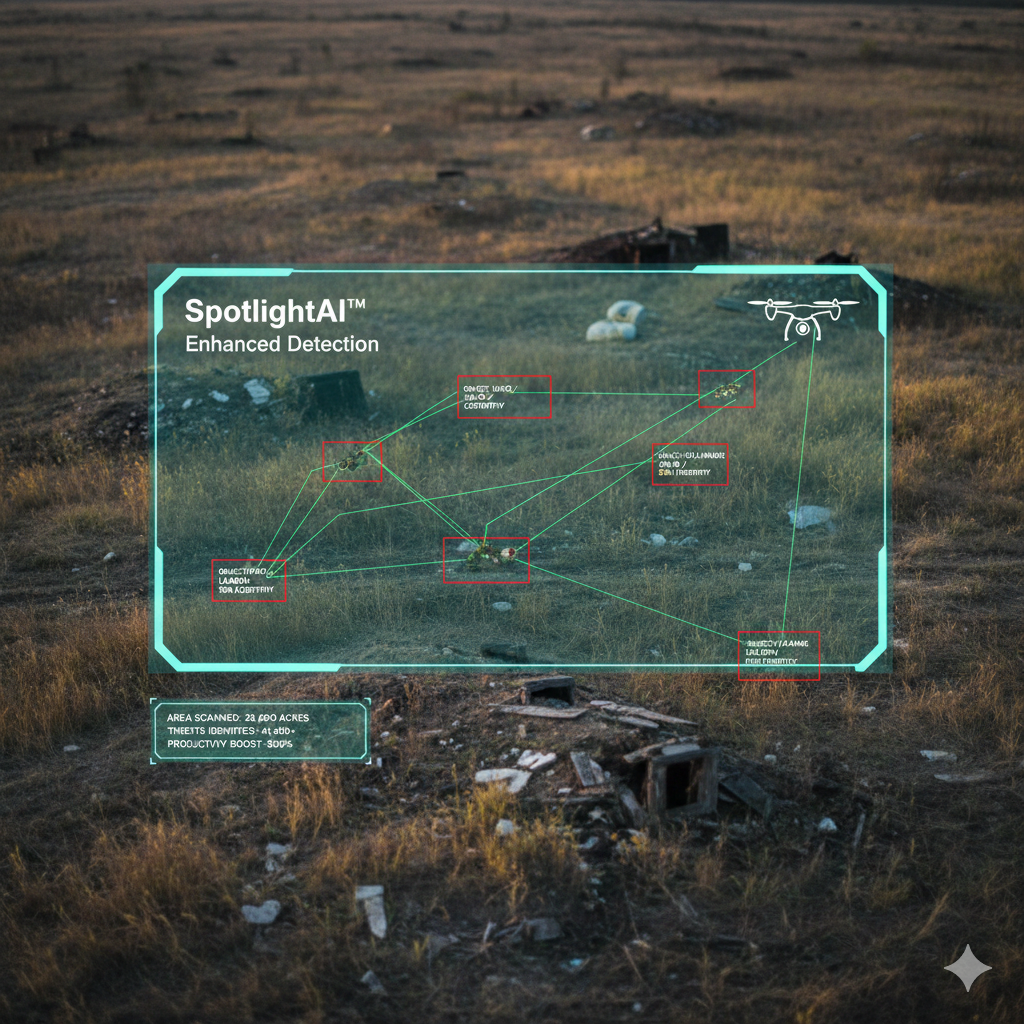
At the heart of Safe Pro’s technological ecosystem is SpotlightAI™, a platform that transforms standard drone imagery into actionable intelligence. The company’s newly filed patent acts as an “engine upgrade” for this platform.
The effectiveness of this technology has already been demonstrated in one of the world’s most challenging environments: Ukraine. Recent reports indicate that Safe Pro’s AI has delivered an 800% surge in productivity for demining surveys. By automating the identification of explosives, the system allows human demining teams to focus their efforts on confirmed danger zones, significantly reducing the time and risk involved in land clearance.
To date, Safe Pro’s unique datasets—which include over 2.2 million drone images and more than 41,400 identified threats across 28,000 acres—provide a “real-world” training ground that few competitors can match. This data-driven approach ensures that the algorithm is battle-tested and optimized for the chaotic visual environments of active conflict zones and post-war reconstruction sites.
Strategic Integration with the U.S. Military
The filing of this patent comes at a strategic time as Safe Pro deepens its relationship with the U.S. Department of Defense. The company has confirmed it will showcase these enhanced AI capabilities during several high-profile events with the U.S. Army throughout 2026.
Key demonstrations will include:
- The Concept Focused Warfighter Experiment (CFWE): A venue for testing cutting-edge tech in simulated combat scenarios.
- The Live Breach Event: Where the AI’s ability to detect obstacles and explosives in real-time will be put to the test.
- CFWE Maneuver (CFWE-M): A demonstration focusing on how autonomous detection can support troop movement and battlefield awareness.
By securing the IP for these “Precision Enhancement” methods, Safe Pro is positioning itself as a vital contractor for modern “mosaic warfare,” where distributed drone networks provide the primary eyes for ground commanders.
A Growing Global IP Fortress
This latest filing is a continuation of Safe Pro’s aggressive strategy to protect its technological moat. The company already holds US Patent No. 12,146,729, which covers the autonomous detection, identification, and labeling of explosives in orthomosaic images. Valid until 2043, this foundational patent establishes Safe Pro as a primary gatekeeper of AI-driven explosive detection.
Furthermore, Safe Pro is expanding its reach far beyond U.S. borders. The company has entered the “national phase” of its international applications under the Patent Cooperation Treaty (PCT). This includes seeking protection in 47 jurisdictions, including the European Union, Canada, Australia, Japan, Israel, and Ukraine.
“Protecting our innovations through a robust international IP strategy is paramount,” the company noted in its disclosure. “Whether deployed on the ‘edge’ via SpotlightAI™ OnSite for real-time analysis or leveraging the cloud via Amazon Web Services (AWS), our technology is built to scale globally.”
Commercial and Humanitarian Implications
While defense applications often capture headlines, the commercial and humanitarian implications of this patent are equally profound. In the agricultural sector, the same “small object detection” precision can be used to identify specific crop pests or early signs of disease from the air, long before they are visible to the naked eye.
In humanitarian terms, the technology offers a path toward a “mine-free world.” By lowering the cost and increasing the speed of landmine detection, Safe Pro’s AI can help return agricultural land to farmers and safe paths to school children in post-conflict nations. The ability to distinguish between a rusted soda can and a lethal anti-personnel mine with high confidence is the “holy grail” of demining—and Safe Pro’s new patent suggests they are closer than ever to achieving it.
Market Outlook and Investor Sentiment
The market has taken notice of Safe Pro’s momentum. Despite the inherent volatility in the tech and defense sectors, the company’s steady accumulation of IP and its $14 million in recent funding from partners like Ondas Holdings Inc. suggest strong institutional confidence.
Investors are increasingly looking for “AI-plus” companies—those that don’t just develop software, but apply it to tangible, high-barrier-to-entry physical problems. Safe Pro Group fits this description perfectly, combining sophisticated machine learning with the rugged requirements of field security and explosive ordnance disposal (EOD).
Conclusion
The filing of the “Object Detection Precision Enhancement” patent is more than just a legal formality; it is a statement of intent. By solving the technical limitations of drone-based computer vision, Safe Pro Group is making the world safer, one pixel at a time.
As the company prepares for its 2026 demonstrations with the U.S. Army, the focus will remain on the transition from “seeing” to “understanding.” In the high-stakes environments where Safe Pro operates, the difference between a successful mission and a tragedy often comes down to the speed and accuracy of an algorithm. With this new patent, Safe Pro Group has ensured that its AI will remain at the forefront of that life-saving frontier.
About Safe Pro Group Inc.
Safe Pro Group Inc. is a US-based provider of safety and survival solutions for military, law enforcement, and humanitarian organizations. Their SpotlightAI™ platform represents the cutting edge of autonomous threat detection, leveraging massive geospatial datasets to identify risks in complex environments.
The Patent Paradox: Why India’s Startup Filing Surge is 83% Failure and All About Optics
A deep dive into the intellectual property (IP) landscape of India’s booming startup sector reveals a critical gap between ambition and execution, suggesting that the much-lauded surge in patent filings is predominantly a tactical exercise in investor signalling rather than a genuine marker of technological innovation. The core issue, critics argue, is a “crisis of intent” where patents function as “decorative rather than functional” assets.
While global bodies like the World Intellectual Property Organization (WIPO) have celebrated India’s rapid ascent—the WIPO 2024 report noted a phenomenal 15.7% growth in patent applications in 2023, positioning the country 6th globally with 64,480 filings —the internal data paints a sobering picture of weak follow-through.
The Data Gap: 83% of Startup Patents Fail to Secure a Grant
Analysis of the startup patent pipeline from 2021 through 2025 reveals a profound drop-off rate, demonstrating that the vast majority of filings are not carried through to completion.
During this five-year period, Indian startups filed a robust 13,089 patent applications. Yet, only 2,174 of these successfully navigated the examination process to achieve the grant stage. This results in a grant success rate of barely 16.6%, meaning approximately one out of every six startup filings becomes an enforceable, proprietary asset.
The failure rate is compounded by active abandonment. Nearly 500 startup patent applications were explicitly withdrawn or abandoned early, often due to the filers failing to complete detailed specifications or respond to subsequent office actions required by the Patent Office.
This pattern extends beyond patents. Startups filed 44,517 trademark applications during the same period, with over 1,300 subsequently abandoned. Analysts suggest this widespread non-prosecution across IP types confirms that the primary function of the filing is “brand optics” rather than a rigorous, long-term IP strategy. The high volume of dropped applications confirms that for many, the intent was temporary and instrumental: the patent filing was merely a transaction used to secure funding, not an investment in an enduring intellectual asset.
Investor Mandate: Patents as Pitch Deck Tools
The distortion in filing behaviour is traced back to the venture capital (VC) ecosystem’s preference for strong valuation narratives. In competitive fundraising rounds, a pending patent application, particularly a cheap and fast provisional filing, serves as a high-visibility proxy for technological differentiation and market moat potential.
A provisional patent application, which secures an immediate priority date, is leveraged as a “fast, affordable way to strengthen a fundraising narrative” and “create the appearance of a breakthrough innovation”. This mechanism enables a “Capital first, commitment later” ethos.
The systemic issue is rooted in the fact that investors often prioritize the inclusion of an IP slide over demanding proof of prosecution commitment or demonstrated R&D investment. As the analysis notes, “Once the funding round closes, priorities may shift,” leading to a predictable loss of enthusiasm for the labour-intensive and expensive work required to turn provisional filings into complete specifications. This rational response by founders—underinvesting in expensive, long-term R&D in favour of cheap, high-volume filing tactics—systematically shifts resources away from core innovation.
Structural Deficiency: India’s R&D Investment Stagnation
The crisis of intent at the startup level is underpinned by a deep, structural R&D deficit at the national level. The commitment to deep, foundational research necessary to generate truly novel and patentable inventions remains structurally low in India.
Official data from the Department of Science & Technology (DST) confirms that India’s Gross Expenditure on Research and Development (GERD) as a percentage of GDP stood at 0.64% during the fiscal year 2020–21, having remained stagnant between 0.6% and 0.7% in the preceding years (0.66% in 2018–19 and 2019–20).
This figure is significantly “below global average and lower than countries like China, South Korea and US”. This structural weakness is compounded by low private sector contribution, which accounted for only 36.4% of the total GERD in 2020–21, in sharp contrast to innovation-leading nations where private industry drives over 70% of R&D expenditure.
This macro-level underinvestment directly correlates with the micro-level deficiencies, as most startups lack “dedicated research teams, technical drafting expertise, prior-art assessment systems, and time for iterative processes” necessary for rigorous patent prosecution.
Policy Flaw: Incentives Reward Filing, Not Granting
Current government policies designed to stimulate IP activity, while successful in boosting filing volume, have inadvertently intensified the focus on volume over quality. The government successfully implemented significant fee concessions, including an 80% reduction in patent filing fees for startups, MSMEs, and educational institutions.
However, the design flaw is that these incentives are tied to the input stage (filing) rather than the output stage (grant or commercialization). By heavily subsidizing the initial filing, the state inadvertently subsidizes the creation of the fundraising narrative for VCs. Once the provisional application is lodged, the startup has secured its priority date and the narrative benefit, but the subsequent costly work of prosecution remains unassisted, cementing the low-commitment behaviour.
Blueprint for Genuine Innovation: Shifting from Decoration to Depth
To foster genuine innovation and correct the systemic inefficiencies, experts advocate for a strategic overhaul of incentives and infrastructure.
- Realign Incentives: Government benefits, including subsidies and fast-track examination provisions, must be decoupled from the act of filing and strategically tied to demonstrable outcomes, such as patent grants, successful long-term renewal, or demonstrable commercial utilization.
- Enhance Capacity: Urgent investment in the Patent Office is mandatory, including expansion of examiner capacity and specialized domain expertise. There is a pronounced need for more technically specialized patent officers, particularly in cutting-edge technological areas like AI, biotech, semiconductors, climate-tech, and advanced manufacturing.
- Strengthen R&D Culture: The government should offer targeted, co-funded grants and innovation-linked incentives for startups that demonstrate a commitment to establishing and maintaining dedicated R&D teams or formalized collaboration with research institutions.
- Promote Co-patenting: Actively promoting policy frameworks that encourage joint patent filings (co-patenting) between startups and premier academic/research institutions, such as the IITs and national labs, would guarantee a higher technical standard for the filings and create structured pathways for knowledge transfer.
The conclusion remains clear: for India to genuinely transition from an IP volume leader to a global innovation power, the focus must shift from decorative filings to functional intellectual assets. Only then can “depth replace decoration” and solidify India’s reputation as a serious, quality-driven innovation hub.
Chandigarh Students Secure Patent for ‘GestureX’ – Revolutionary Smart Glasses that Translate Speech into Sign Language
In a breakthrough moment for accessible technology in India, a team of students from Chandigarh has been awarded a design patent for their innovative invention – GestureX, a pair of smart glasses that can convert spoken language into sign language in real-time. This pioneering project aims to bridge communication gaps for the hearing-impaired, enhancing inclusivity in education, workplaces, and daily life.
Breaking Communication Barriers with Technology
GestureX represents a significant leap in assistive wearable technology. The device is expected to transform how individuals with hearing disabilities interact with the world around them, particularly in environments where sign language interpreters are unavailable.
The patent, granted under Class 16-06 (relating to communication equipment), marks formal recognition of the students’ innovation, positioning GestureX as a potential game-changer in inclusive communication tools.
How GestureX Works
The functionality of GestureX is underpinned by a combination of hardware and software components that work seamlessly together:
Built-in Microphones: The glasses are fitted with directional microphones that capture ambient speech in real-time.
Speech Recognition Engine: Advanced software processes spoken words and converts them into text-based commands.
Sign Language Renderer: A miniature display system integrated into the glasses projects animated sign language gestures that correspond to the recognized speech.
Efficient Power Management: Designed with lightweight battery systems, GestureX ensures portability and extended battery life for regular use.
The glasses have been optimized to recognize multiple accents and background noise, ensuring accuracy in varied environments like classrooms, conferences, or public transport.
Designed by Students, Backed by Innovation
The team behind GestureX comprises students from diverse technical backgrounds who came together with a shared vision to make technology more inclusive. Motivated by personal experiences and community challenges, the team sought to develop a tool that could empower the deaf and hard-of-hearing communities with greater independence and confidence.
According to the team spokesperson, “Our goal was to build something meaningful that could help real people in real situations. GestureX is not just a gadget—it’s a step toward equal access and inclusive communication.”
Broader Implications and Future Development
GestureX’s creators are in discussions with academic institutions and healthcare providers to initiate pilot testing of the device. Early trials will help refine the technology, particularly for use in multilingual settings where regional sign language variants are common.
Looking ahead, the team plans to integrate artificial intelligence to allow the glasses to adapt to individual speech patterns, improve gesture accuracy, and potentially support reverse translation—from sign language to spoken words—to facilitate two-way communication.
They are also exploring partnerships for manufacturing and scaling the product, with the aim of keeping it affordable for individuals and organizations that serve the deaf and hard-of-hearing communities.
A Leap Forward in Assistive Tech
As India continues to promote inclusive innovation through programs like Startup India and the Atal Innovation Mission, projects like GestureX highlight the role of youth-led innovation in solving socially relevant problems. The device stands as a testament to the power of interdisciplinary collaboration and the potential for accessible design to foster greater equity in communication.
If successfully commercialized, GestureX could join the ranks of transformative assistive devices, not only within India but globally, providing a much-needed communication bridge in an increasingly interconnected world.
University of Hyderabad Researchers Secure Patents for Pioneering Innovations in Materials Science
The patents, awarded to faculty members from the School of Physics and the Advanced Centre of Research in High Energy Materials (ACRHEM), underscore UoH’s growing impact in high-performance materials research with wide-ranging industrial applications.
Innovation in 3D Ceramic Resonators
The first patent, titled “Dielectric Resonators with Complex 3D Geometries Using Gel Casting Techniques,” is credited to Professors K.C. James Raju and V. Seshubai, along with research scholars T. Anil and Swarup Raju. This novel method facilitates the production of high-temperature ceramic dielectric resonators molded into intricate three-dimensional structures.
Traditionally, creating 3D resonators from ceramic materials poses significant challenges due to their brittle nature and high processing temperatures. The patented gel casting approach overcomes these limitations, enabling the fabrication of compact and high-performance resonators suitable for next-generation microwave and millimeter-wave communication systems.
“This technique opens new pathways for designing miniaturized antennas and frequency filters, particularly in 5G and satellite communication devices,” explained Prof. Raju.
Breakthrough in Low-Temperature Crystallization
The second patent focuses on the laser-based crystallization of ferroelectric thin films, a breakthrough that significantly lowers the thermal requirements for these critical materials. Spearheaded again by Prof. K.C. James Raju and his team, the technique successfully reduces the crystallization temperature from 700°C to 300°C by utilizing controlled laser irradiation.
This innovation has significant implications for the electronics industry, particularly in the integration of ferroelectric materials into semiconductor devices, which typically cannot endure high processing temperatures. Lower thermal thresholds enable the application of these films in tunable microwave components, sensors, and energy-efficient electronic devices.
“This development bridges the gap between high-performance ferroelectric materials and practical device manufacturing,” noted Prof. Raju.
UoH’s Growing Patent Portfolio
With these two patents, the University of Hyderabad continues to expand its footprint in applied scientific research and industrial collaboration. The institution has increasingly focused on promoting innovation that addresses real-world challenges in communication, electronics, and advanced materials.
Vice-Chancellor Prof. B.J. Rao praised the research teams for their work, stating, “These achievements are a testament to the University’s commitment to fostering a research environment that supports both theoretical advancement and practical application.”
Looking Ahead
As global industries seek cost-effective and scalable technologies in electronics and telecommunications, the breakthroughs from UoH researchers could play a pivotal role in shaping future solutions. The university also aims to collaborate with industries and startups to bring these patented technologies from the lab to the market.
While the university has yet to announce any patent specifically related to alpha alumina platelets, these recent innovations indicate that UoH remains a leader in cutting-edge materials science research with broad commercial potential.
Donald Trump Urged to Target ‘Lazy Patent Expansion’ in U.S. Drug Bill Push
The Problem: Patent Thickets and Evergreening
Saynor criticized the practice of “evergreening,” where brand-name drug manufacturers file numerous patents on slight modifications of existing drugs to extend their market exclusivity. This strategy, often referred to as creating “patent thickets,” has been used to delay the entry of generic competitors, thereby maintaining high drug prices. For instance, blockbuster drugs like AbbVie’s Humira have been subject to extensive patent filings, with over 140 patents filed per top-selling drug, causing prices to remain high and limiting competition.
Impact on Generic Drug Market
Generic drugs account for approximately 90% of prescriptions in the U.S. and are significantly more affordable than their branded counterparts. However, the proliferation of patent thickets has led to shortages and limited availability of generics. Saynor highlighted that the rebate system, which involves pharmacy benefit managers, further inflates drug costs, making it more challenging for generics to compete.
Proposed Solutions
To address these issues, Saynor advocated for reinstating a six-month exclusivity period for first-to-market generics, a policy that could incentivize the development and availability of affordable alternatives. Additionally, he cautioned against proposed pharmaceutical tariffs, which could disproportionately impact generics due to their low margins and reliance on overseas production.
Legislative Efforts and Challenges
Bipartisan efforts to reform the patent system have been introduced in Congress, targeting practices like patent thickets, product hopping, and pay-for-delay agreements. Despite strong support, these bills have faced obstacles in becoming law, often due to legislative gridlock and opposition from industry stakeholders.
Global Implications
Trump’s “most favored nation” policy, which seeks to align U.S. drug prices with those paid by other countries, has raised concerns internationally. In the UK, for example, where branded drugs cost significantly less than in the U.S., pharmaceutical firms may respond by raising prices elsewhere or withholding drugs from certain markets. This could strain healthcare systems globally and potentially discourage pharmaceutical innovation.
Conclusion
As the U.S. continues to grapple with high drug prices, addressing the issue of “lazy patent expansion” is crucial for fostering a competitive and affordable pharmaceutical market. While Trump’s policy initiatives aim to reduce costs, comprehensive reform of the patent system is necessary to ensure long-term access to essential medications for all Americans.
Maruti Suzuki e-Vitara Patented in India; Launch Scheduled for September 2025
Design and Platform
The e-Vitara is built on the Heartect-e platform, a collaboration between Suzuki and Toyota. This platform integrates eAxles, combining the motor and inverter into a single unit, enhancing efficiency and performance. The SUV features a rugged design with elements like 3-point Matrix LED DRLs, rear lamps, 18-inch alloy wheels, and active air vents at the front to improve aerodynamics .
Battery Options and Range
Maruti Suzuki offers two battery pack options, the larger 61 kWh battery is expected to provide a range of over 500 km on a single charge, making it competitive in its segment .
Interior Features
Inside, the e-Vitara boasts a modern cabin with a 10.25-inch instrument cluster, ambient lighting, a floating center console, a wireless charging pad, and a panoramic glass roof. The SUV also offers a 10-way electrically adjustable driver’s seat and a 40:20:40 split rear seat configuration, enhancing comfort and practicality .
Safety and Technology
Safety features include seven airbags as standard across all variants, a 360-degree camera, and a suite of Advanced Driver Assistance Systems (ADAS). These features aim to provide a high level of safety for occupants .
Pricing and Launch Details
The e-Vitara is expected to be priced competitively, with the base 49 kWh variant starting around ₹20 lakh (ex-showroom). The 61 kWh variant could be priced at approximately ₹25 lakh, while the AllGrip-e AWD model may approach ₹30 lakh . Production is set to commence at Maruti’s Gujarat plant, with exports planned to over 100 countries, including Europe and Japan .
Competitors in the Indian Market
Upon launch, the Maruti Suzuki e-Vitara will compete against several established and upcoming electric SUVs in India, including:
Tata Curvv EV: Expected to be priced between ₹17.49 lakh and ₹22.24 lakh .
Mahindra BE 6: Priced at ₹18.90 lakh .
Hyundai Creta Electric: Expected to be priced between ₹17.99 lakh and ₹24.38 lakh .
MG ZS EV: Priced between ₹18.98 lakh and ₹26.64 lakh .
With its competitive pricing, advanced features, and robust performance, the Maruti Suzuki e-Vitara is poised to be a strong contender in the Indian electric SUV market.
Delhi High Court Clarifies Patent Law Standards in Landmark Ruling on Section 3(d) of the Indian Patents Act, 1970
Section 3(d): A Barrier to Evergreening
Section 3(d) of the Indian Patents Act is a unique provision designed to prevent the “evergreening” of patents—where pharmaceutical companies attempt to extend patent monopolies by making minor modifications to known substances. The provision stipulates that a new form of a known substance is patentable only if it results in a significant enhancement of efficacy. In the context of pharmaceutical inventions, the Supreme Court, in its 2013 ruling in Novartis AG v. Union of India, interpreted “efficacy” to mean “therapeutic efficacy.”
The Ischemix LLC Case: Background
Ischemix LLC filed an appeal against the rejection of its patent application (No. 9739/DELNP/2011) by the Indian Patent Office on the grounds of Section 3(d). The applicant argued that they had submitted robust data—spanning in-vitro, in-vivo, and clinical trial results—along with expert opinions to demonstrate the enhanced therapeutic efficacy of the compound.
The Patent Office, however, rejected the application, noting that while comparative data had been submitted after the oral hearing, the data was not clearly explained or sufficiently correlated to therapeutic enhancement as claimed in the specification.
High Court’s Ruling: Key Takeaways
1. Therapeutic Efficacy as the Benchmark
The Delhi High Court reaffirmed the principle established in Novartis AG v. Union of India—that efficacy in the context of pharmaceutical patents must be understood as therapeutic efficacy. Mere improvements in physicochemical properties like stability or solubility are insufficient unless they translate to demonstrable therapeutic benefits.
2. Comparative Data: A Necessary Requirement
Drawing from its earlier ruling in DS Biopharma Limited v. Controller of Patents, the Court stressed that applicants must furnish comparative efficacy data to demonstrate enhancement over known substances. Importantly, this data should be provided in the form of structured comparative tables and supported by appropriate scientific evidence.
3. Admissibility of Post-Filing Data
The Court recognized the inherent delay in generating empirical efficacy data, especially in the pharmaceutical sector where clinical trials are time-intensive. It ruled that while some indication of efficacy should be included at the time of filing, post-filing data may be considered if it corroborates the technical effects disclosed in the original specification. This position is consistent with the Calcutta High Court’s judgment in Oyster Point Pharma Inc. v. Controller of Patents, which acknowledged the prolonged timeline for drug development.
4. Timing and Explanation of Additional Data
The Court made it clear that post-filing data must be submitted well before the final hearing at the Patent Office and should be clearly explained. Submitting complex efficacy data during written submissions post-hearing without oral explanation could render it ineffective, as the Controller may struggle to appreciate the technical details.
5. Requirement for Correlation with Specification
Referring to AstraZeneca AB v. Intas Pharmaceuticals Ltd., the Court ruled that post-filing data should only confirm technical effects already hinted at or described in the specification. It cannot be used to introduce an entirely new technical effect.
Court’s Direction in Ischemix Case
Recognizing the importance of the data but noting the lack of explanation linking the data to therapeutic efficacy, the Court directed Ischemix LLC to submit an explanatory note correlating the submitted evidence to enhanced efficacy. Upon the Patent Office’s consent, the Court remanded the application for re-examination, thereby allowing a fair opportunity for reconsideration.
Broader Implications for Patent Law
This judgment offers significant guidance to pharmaceutical companies and patent practitioners navigating Section 3(d). It strikes a delicate balance between encouraging genuine innovation and preventing the misuse of the patent system to monopolize marginal improvements. The judgment also reinforces procedural discipline, requiring that critical data be timely, complete, and clearly presented.
Conclusion
The Delhi High Court’s decision in Ischemix LLC v. The Controller of Patents builds upon the jurisprudence laid down in Novartis and contributes to a growing body of case law interpreting Section 3(d). As patent litigation continues to evolve in India’s dynamic pharmaceutical sector, such decisions will serve as important references for determining the scope of patentable subject matter and the treatment of post-filing evidence.
Legal experts expect that the continued engagement of the judiciary with Section 3(d) will bring greater predictability and transparency to India’s patent system, particularly for drug-related inventions.
India Breaks into Top Six Globally in 6G Patent Filings: MoS Telecom
Strategic Push for 6G Leadership
Under the ‘Bharat 6G Vision,’ India aims to become a leader in the design, development, and deployment of 6G technology by 2030. The government is actively supporting this initiative through various programs, including funding research and development, establishing testbeds, and fostering collaborations between academia and industry. These efforts are expected to contribute to India’s goal of securing a 10% share of global 6G patents and one-sixth of contributions to global standards within the next three years .
Terahertz Frequency Bands: The Heart of 6G Innovation
6G technology is set to revolutionize wireless communication by operating in terahertz (THz) frequency bands, specifically between 95 GHz and 3 THz. This spectrum allows for data rates up to 1 terabit per second, marking a hundredfold increase over 5G speeds. Such capabilities will enable applications like immersive extended reality, digital twins, and seamless integration of terrestrial and non-terrestrial networks .
To facilitate research and development in these high-frequency bands, the Telecom Regulatory Authority of India (TRAI) has recommended setting up experimental authorizations for operations in the THz spectrum. This move is expected to position India as a global hub for 6G R&D .
Collaborative Efforts and Future Outlook
India’s ascent in 6G patent filings is attributed to a combination of government initiatives, private sector investments, and academic collaborations. Telecom giants like Reliance Jio, Bharti Airtel, and Tata Communications are investing heavily in 6G research, establishing research centers, and forming international partnerships to drive innovation .
Looking ahead, India is set to host the World Telecommunications Standardisation Assembly (WTSA) in Delhi from October 14 to 24, 2024.
Conclusion
India’s entry into the top six nations for 6G patent filings signifies a strategic leap towards becoming a global leader in next-generation wireless technology. With continued investment in research, infrastructure, and international collaboration, India is poised to play a pivotal role in defining the future of telecommunications.
Delhi High Court Grants Relief to Indian Businessman in ‘ELFY’ Trademark Dispute with Pakistani National
In a significant ruling, the Delhi High Court has granted relief to an Indian businessman in a trademark dispute involving the mark ‘ELFY’ against Pakistani national Mohammed Younus Sheikh. The court’s decision underscores the importance of protecting intellectual property rights and upholding fair business practices.
Background of the Case
The dispute centers around the use of the ‘ELFY’ trademark, which the Indian businessman claims to have developed and used in commerce for several years. Mohammed Younus Sheikh, a Pakistani national, had claimed that his company had been using the ‘ELFY’ mark for industrial adhesives since 1981. Sheikh’s company had registered the mark in Pakistan and asserted that it had acquired a transborder reputation, particularly in India.
The Indian businessman contended that he had been using the ‘ELFY’ mark in India since 1988 and had built a significant reputation and goodwill associated with the mark. He argued that Sheikh’s adoption of the same mark in India was likely to cause confusion among consumers and harm his business interests.
Court’s Findings
The Delhi High Court examined the evidence presented by both parties, including the dates of adoption and use of the ‘ELFY’ mark, marketing materials, and consumer testimonials. The court found that the Indian businessman had established prior use of the mark in India and had built a recognizable brand associated with ‘ELFY.’
In contrast, the court noted that Mohammed Younus Sheikh had not provided sufficient evidence to demonstrate prior use or registration of the ‘ELFY’ mark in India. The court emphasized the principle of territoriality in trademark law, asserting that the rights to a trademark are generally confined to the jurisdiction where the mark is used and recognized.
Legal Implications
This ruling reinforces the importance of establishing and maintaining clear records of trademark use and registration. It also highlights the challenges businesses may face when operating in international markets, where the risk of trademark disputes can arise due to similarities in branding.
Legal experts suggest that businesses should conduct thorough trademark searches before adopting new marks and consider registering their trademarks in key markets to protect their brand identity and prevent potential conflicts.
Conclusion
The Delhi High Court’s decision serves as a reminder of the complexities involved in trademark law and the need for businesses to be vigilant in protecting their intellectual property. As global commerce continues to expand, understanding and navigating trademark rights across different jurisdictions will be crucial for businesses seeking to safeguard their brands.